Cuba’s Authoritarian Nexus
CANADA’S CUBA BLIND SPOT: How Ottawa’s Inconsistent Approach Undermines Democracy in the Americas
By Michael Lima, Isabelle Terranova, and Sarah Teich
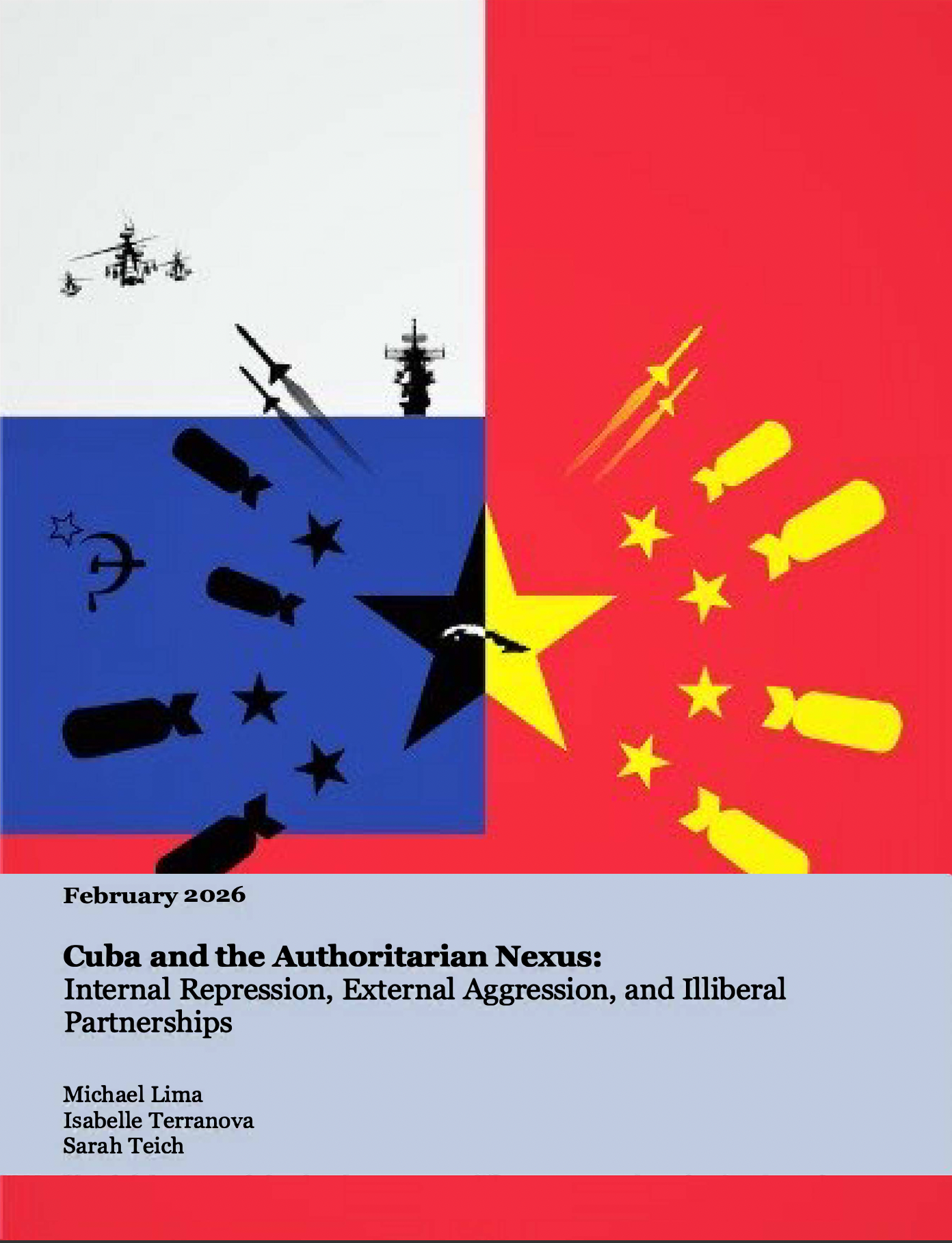
[Note: This commentary was originally published by the Macdonald-Laurier Institute based in Ottawa, Canada and draws from our longer report,“Cuba and the Authoritarian Nexus: Internal Repression, External Aggression, and Illiberal Partnerships”
On January 3, 2026, U.S. special forces captured Venezuelan dictator Nicolás Maduro in a military operation that extracted him and his wife to the United States. In the operation, 32 members of Cuba’s elite “Black Wasps” counter-insurgency unit were killed protecting him; Havana subsequently declared two days of national mourning (14ymedio 2026; Prensa Latina 2026). The Cuban regime’s response lays bare a reality that Canada has long preferred to ignore: Cuba is not simply a poor Caribbean nation struggling under U.S. sanctions. It is an active participant in an authoritarian network that spans continents, exports repression, and works systematically to undermine democratic governance across the Western Hemisphere.
Yet while Canada has imposed targeted sanctions on Venezuelan officials (Global Affairs Canada 2025), publicly condemned the Maduro regime (Blanchfield 2019), and taken leadership roles in defending democracy in Latin America, it has treated Cuba with remarkable deference. Former Prime Minister Justin Trudeau referred to the Cuban regime as an “ally” (Dyer 2019). Not a single Cuban official has faced Canadian sanctions despite decades of documented human rights abuses. (Lima and Teich 2025). Cuban state propaganda broadcasts freely into Canadian homes while Russian channels have been banned (Teich and Lima 2024). This double standard has not gone unnoticed—and it is increasingly untenable.
As Cuba deepens its partnerships with Russia, China, and Venezuela, the consequences extend far beyond the island. Cuban nationals are being trafficked to fight in Russia’s war against Ukraine (Diaz-Balart National Security Briefing 2025). Cuban intelligence personnel train security forces across Latin America in surveillance and crowd control (Berwick 2019; Rendon and Fernandez 2020; Castañeda 2024). Experts increasingly warn of Russian and Chinese spy facilities on the island (Kanev 2023; Funaiole et al. 2024). And through it all, Canada maintains the pretense that engagement without accountability will somehow encourage reform.
“Cuba’s authoritarian alliances are not driven by economic desperation but by ideological commitment and strategic calculation.”
It will not. After more than 65 years, the evidence is overwhelming: Cuba’s authoritarian alliances are not driven by economic desperation but by ideological commitment and strategic calculation. As democracies worldwide confront an emboldened authoritarian bloc, Canada can no longer afford to treat Cuba as an exception. It is time for Ottawa to align its Cuba policy with its stated commitment to human rights, democratic governance, and the rule of law.
CUBA’S AUTHORITARIAN SYSTEM: A BRIEF HISTORY
To understand Cuba’s role in today’s authoritarian nexus, one must first understand the regime’s domestic foundations. Since Fidel Castro consolidated power in 1959, Cuba has functioned as a one-party state with no meaningful space for political opposition, independent media, or civil society organizations that operate beyond state control.
Elections in Cuba serve as rituals of regime legitimacy rather than mechanisms of democratic accountability (14ymedio 2023). The Cuban Constitution allows only candidates approved by the Communist Party to run for office. Independent candidates face systematic exclusion, harassment, and arrest (Agence France-Presse 2022; Pellegrini and Marco 2023). In the 2023 parliamentary elections, opposition candidates reported intimidation, detention, and violence designed to prevent their participation (Pellegrini and Marco 2023). As political scientist and activist Manuel Cuesta Morúa has observed, Cubans can vote, but they cannot choose (Cuesta Morúa and Jennische 2023).
The Cuban penal code criminalizes virtually all forms of dissent. Crimes of publishing “false news” and “public disorder” are broadly defined and selectively enforced, giving authorities near-unlimited discretion to prosecute critics (The Freedom to Write 2021). The vagueness of these provisions mirrors China’s “picking quarrels and provoking trouble” offense (Davidson 2023), underscoring that this is a tool that both regimes use to institutionalize repression under the guise of operating under rule of law.
As of December 2025, Cuba had arbitrarily detained 1,192 political prisoners (Prisoners Defenders 2025). Prisoners face torture, prolonged solitary confinement, denial of medical care, sexual assault, and brutal beatings (Human Rights Watch 1999; U.S. House of Representatives 2012; Prisoners Defenders 2022). At least four detained protesters have died in custody while protesting or enduring these inhumane conditions (OCDH 2024). These deaths receive minimal international attention.
Internet access serves as a weapon of control. Since the backbone of the internet infrastructure in Cuba is controlled by the government, it has been able to harness Chinese technology to restrict access and block communications platforms that might facilitate organizing. During protests or politically sensitive moments, authorities shut down mobile data nationwide or throttle bandwidth to prevent real-time documentation of state violence. During the July 11, 2021 pro-democracy protests—the largest in decades—the regime sharply restricted internet access to limit international awareness of its crackdown (Lazarus and Ellis 2021).
The economic system reinforces political control. Conglomerates controlled by the Cuban Armed Forces, including GAESA, virtually oversee the tourism industry and control a significant portion of the economy (Gamez Torres 2026). Consequently, foreign investment often flows directly to military-controlled enterprises that use those resources to fund surveillance, monitor dissidents, and purchase technology for digital repression. The vast majority of Cubans remain excluded from meaningful economic participation, surviving in what amounts to a garrison state disguised as socialism.
This is the foundation upon which Cuba’s illberal partnerships are built. Understanding this domestic reality is essential to understanding Cuba’s role in the global authoritarian network.
CUBA AT THE CENTER OF AN AUTHORITARIAN NEXUS
“Cuba’s relationships with Russia, China, and Venezuela are not merely economic survival strategies. They represent ideological alignments reinforced by decades of cooperation in military affairs, intelligence sharing, and the exchange of repressive techniques.”
Cuba’s relationships with Russia, China, and Venezuela are not merely economic survival strategies. They represent ideological alignments reinforced by decades of cooperation in military affairs, intelligence sharing, and the exchange of repressive techniques.
Russia: From Cold War Ally to Ukraine Recruitment Ground
The Cuba-Russia relationship extends back to the early 1960s, when the Soviet Union emerged as Cuba’s primary benefactor. That partnership involved massive economic subsidies, military aid, and intelligence cooperation, including the establishment of Soviet signals intelligence facilities in Cuba that monitored U.S. communications (Bain 2010 B; Central Intelligence Agency 2011). When the Soviet Union collapsed, the relationship entered a period of dormancy—but it never truly ended (Bain 2010 A).
Under Vladimir Putin, Russia has systematically rebuilt its position in Cuba. Russia forgave $32 billion in Cuban debt (The Guardian 2014), and Russian oil shipments have helped Cuba weather energy crises (Alonso-Trabanco 2024). Investigative reporting in recent years suggests re-established intelligence operations on the island, including facilities with the technical potential to effectively surveil both the United States and Canada (Kanev 2023).
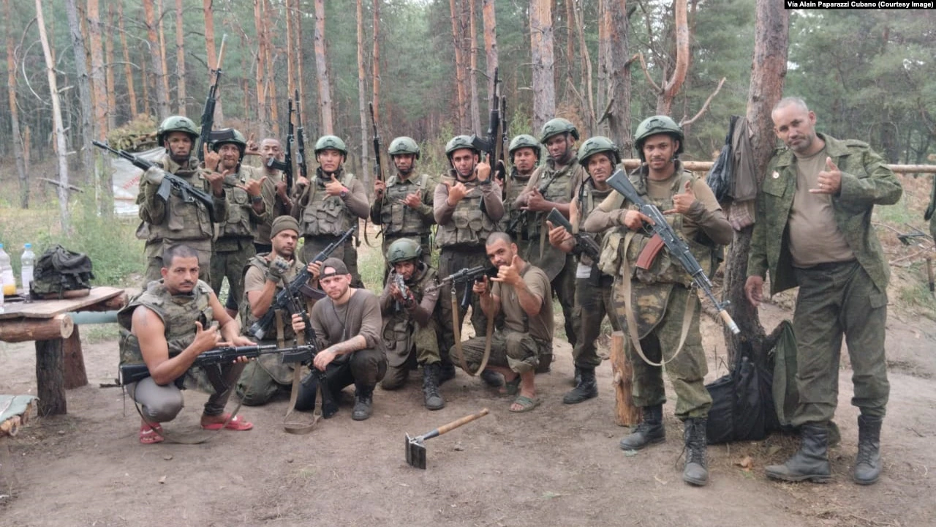
Cubans pose as soldiers of the 137th Parachute Regiment, located in the city of Ryazan. [Photo/Martí Noticias]
But the most alarming development involves human trafficking for military service. Since 2023, Cuba has become a primary recruitment ground for Russia’s war in Ukraine. Thousands of Cuban nationals—many deceived by promises of construction work, Russian citizenship, and monthly salaries of $2,000 USD—have been transported to the front lines. Once in Russia, recruits discover they’ve been conscripted into combat units (Diaz-Balart National Security Briefing 2025; Wiseman 2025). Ukrainian military intelligence estimates that Russia recruited approximately 20,000 Cubans by late 2025 (Diaz-Balart National Security Briefing 2025).
This recruitment operation bears hallmarks of human trafficking: deception, coercion, and exploitation for forced labour. Yet it continues with apparent acquiescence—if not active support—from Cuban authorities. Flight records show synchronized increases in Cuban-Russian flights coinciding with diplomatic visits (León 2025), and the Cuban regime has from the outset expressed support for Putin’s war of aggression against Ukraine (Tril 2025). The recruitment is not accidental; it is systematic.
China: Surveillance Technology and Strategic Partnership
Cuba’s relationship with China evolved differently. After a period of ideological conflict during the Sino-Soviet split, Cuba and China normalized relations in the 1990s (Cheng 2007). That relationship has since deepened into a comprehensive partnership focused on technology transfer, economic investment, and intelligence cooperation.
China has integrated Cuba into its Belt and Road Initiative, extending billions in credit for infrastructure projects while strategically forgiving Cuban debts (Cheng 2007). These economic arrangements reinforce political alignment. Cuba consistently supports Chinese positions at the United Nations, particularly regarding human rights, Taiwan, Hong Kong, and Xinjiang (Permanent Mission of the People’s Republic of China to the UN 2021; CGTN 2021).
China has provided Cuba with surveillance technology essential to maintaining regime control, and Chinese telecommunications companies remain present on the island (Ellis 2022). In 2023, the Biden Administration revealed the China has access to facilities for collecting signals intelligence located in Cuba (Funaiole et al. 2024). Joint military training programs date back over a decade, with reports of the Chinese People’s Armed Police training Cuba’s Special National Brigade as early as 2015 (Domínguez and Martínez Rodríuez 2021).
Venezuela: Exporting Repression and Protecting Dictators
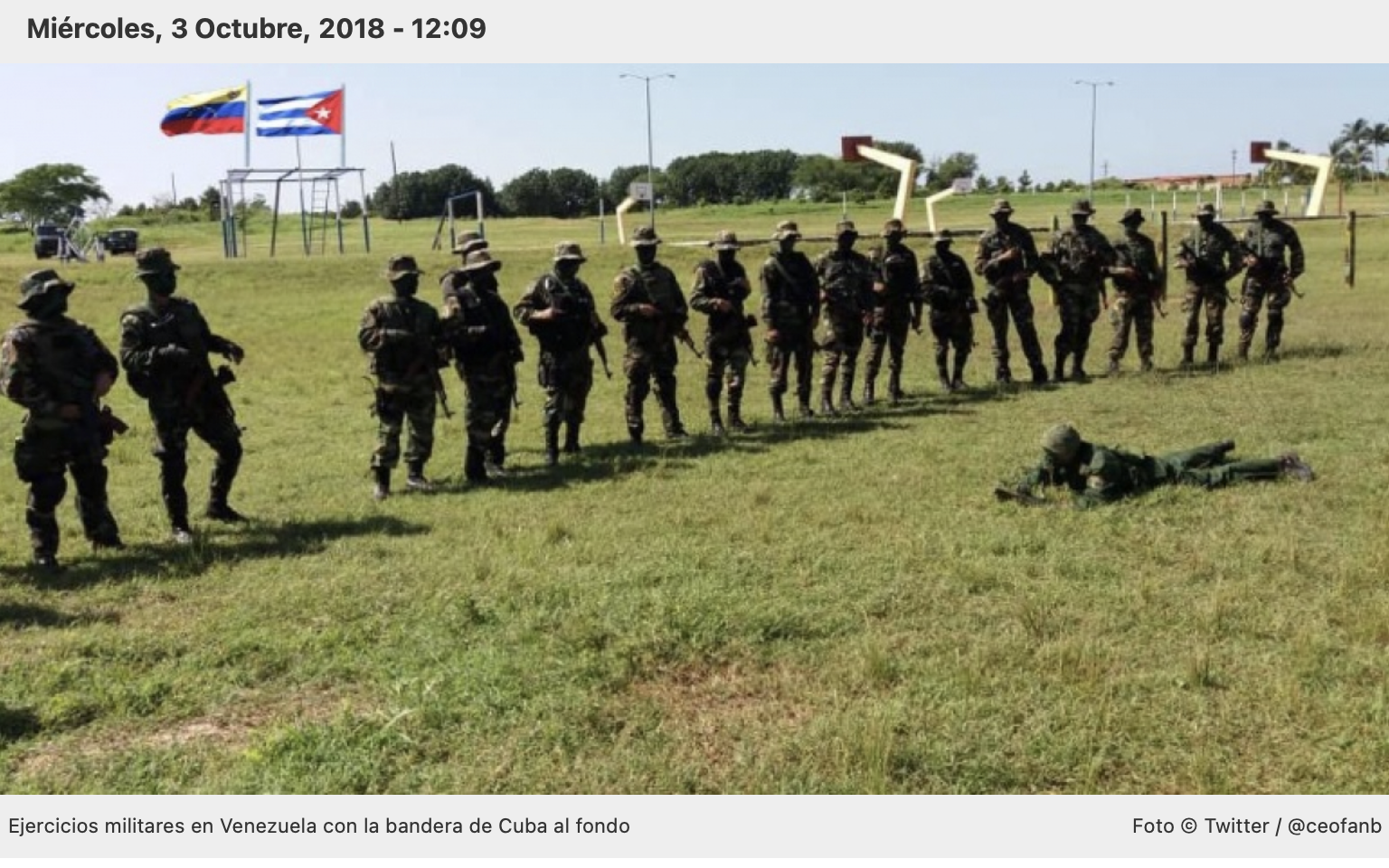
Cuban “Black Wasps” troops took part from September 22 to 29,. 2018 in military exercises in Venezuela alongside the country’s National Armed Forces, according to Infodefensa. [Photo/CiberCuba]
Cuba’s relationship with Venezuela represents perhaps the clearest example of the regime’s willingness to export repression. Beginning in 1999, when Hugo Chávez assumed power, Venezuela relied upon Cuba’s supply of healthcare and education professionals, and intelligence and military advisors. They helped build Venezuela’s domestic intelligence apparatus. And when protests erupted, they coordinated crackdowns (Šerić 2025).
Cuban personnel remain embedded and indispensable in Venezuela’s most repressive institutions, including the General Directorate of Military Counterintelligence (DGCIM), an agency responsible for widespread torture and arbitrary detention (Berwick 2019). The January 2026 operation that killed 32 Cuban security forces revealed the extent of Cuba’s role: even as Maduro fled, Cuban personnel remained to provide last-line protection (Grant 2026).
Cuban intelligence helped Venezuela suppress the 2024 post-election protests following the disputed election. Cuban state media has conducted sustained propaganda campaigns against Venezuelan opposition leaders, particularly María Corina Machado and Edmundo González, using character assassination techniques honed over decades (Mercedes Giráldez 2024.). These campaigns coordinate closely with Venezuelan government messaging, demonstrating integrated information operations across both regimes.
THE CANADA CONTRADICTION
Canada’s approach to Cuba stands in stark contrast to its treatment of other authoritarian regimes, particularly Venezuela and Nicaragua, where Cuban influence runs deep.
Canada has imposed targeted sanctions on 124 Venezuelans under the Special Economic Measures (Venezuela) Regulations, enacted pursuant to the Special Economic Measures Act. Canada has sanctioned Nicaraguan officials. Canada has sanctioned 35 Nicaraguans in relation to gross and systematic human rights violations committed in the country. Canada has sanctioned Russian officials, Belarusian officials, and Chinese officials (Government of Canada ND).
Yet not a single Cuban official has ever been designated under a Canadian sanctions regime, despite overwhelming evidence of torture, arbitrary detention, political imprisonment, forced disappearances, and systematic persecution of dissidents. The contrast is indefensible
Canadian government statements have occasionally criticized Cuban human rights violations, but these statements lack consequences. When Canada condemns Venezuela, sanctions follow. When Canada condemns Cuba, nothing follows. This selective application of principles undermines Canada’s credibility as a defender of human rights and democratic governance.
Not only is this intrinsically unacceptable, but the inconsistent application of Canadian policy creates loopholes that dictators exploit. The most glaring contradiction involves enforcement practices related to combating foreign propaganda networks. In March 2022, the Canadian Radio-television and Telecommunications Commission (CRTC) banned Russian state channels RT and RT France from distribution, recognizing their role in propaganda and disinformation (CRTC 2022). Yet Cubavisión Internacional—the Cuban regime’s state propaganda channel—remains authorized for distribution in Canada (Teich and Lima 2024). These state-owned outlets collaborate. During the Public Inquiry Into Foreign Interference in Federal Electoral Processes and Democratic Institutions, we presented to the Commissioner and to the CRTC’s Director of Broadcasting a two-and-a-half minute video clip of Cubavisión Internacional replaying RT programming, with both Cubavisión Internacional and RT logos visible on screen. Following the Public Inquiry, we sent in a formal complaint. We never received a response.
Another troubling inconsistency is the gap between Canada’s stated policy and actual practice regarding engagement with Cuban civil society in Havana. In October 2024, then-Prime Minister Justin Trudeau testified before the Public Inquiry that Canadian diplomatic missions have a “responsibility” to “engage with civil society organizations and various actors, not just governments.” He stated, “I am actually quite certain that Canada does engage with a range of civil society actors in Cuba, like everywhere else.” (Public Inquiry 2024).
This is false. Pro-democracy activists in Cuba report otherwise. Despite formal requests submitted by Democratic Spaces and Human Rights Action Group since the summer of 2025, and lists of activists we provided with offers to facilitate meetings, the Canadian Embassy in Havana has continued to not engage with independent journalists, opposition groups, or victims of political repression. José Daniel Ferrer, leader of the Patriotic Union of Cuba and one of the island’s most prominent dissidents, clarified that the last time the Canadian Embassy invited his organization to an event was during the Stephen Harper government—over a decade ago.
WHAT CANADA SHOULD DO: TEN CONCRETE RECOMMENDATIONS
Canada cannot afford to maintain its inconsistent approach towards Cuba while claiming leadership on human rights and democratic governance. The 10 recommendations in our report provide a roadmap for aligning Canadian policy with Canadian values.
CONCLUSION: TIME FOR POLICY COHERENCE
“Canada’s approach to Cuba is not simply outdated; it is incoherent.”
Canada’s approach to Cuba is not simply outdated; it is incoherent. Ottawa cannot credibly condemn authoritarianism in Venezuela while treating its primary enabler as an ally. Canada cannot champion human rights at the United Nations while voting to shield Cuba from accountability. Canada cannot ban Russian propaganda while permitting Cuban propaganda. Canada cannot claim to engage with Cuban civil society while refusing to meet with the island’s most prominent dissidents.
It is evident that Cuba is not an isolated regime struggling under U.S. sanctions, but rather an active node in an authoritarian network that includes Russia, China, Venezuela, Nicaragua, Iran, and North Korea. These regimes cooperate militarily, share intelligence, exchange surveillance technology, coordinate propaganda, and work systematically to reshape international norms around human rights and sovereignty.
“As democracies worldwide confront this challenge, Canada must decide whether its Cuba policy serves Canadian values or undermines them.”
As democracies worldwide confront this challenge, Canada must decide whether its Cuba policy serves Canadian values or undermines them. The evidence is clear: current policy fails both strategic and moral tests. Cuba helps Russia recruit fighters for an illegal war of aggression. Cuba provides China with intelligence platforms aimed at democracies in the Western Hemisphere. Cuba trains security forces across Latin America in repression. And through it all, the Cuban people endure one of the world’s oldest dictatorships and most repressive systems with minimal international support.
The recommendations outlined here are not radical. They simply ask Canada to apply to Cuba the same standards it applies elsewhere. Targeted sanctions, public condemnation of abuses, and support for civil society are tools Canada already uses. The question is whether Canada will continue to exempt Cuba from principles it claims to uphold.
The launch of the full report, “Cuba and the Authoritarian Nexus: Internal Repression, External Aggression, and Illiberal Partnerships,” provides an opportunity for Canada to reconsider its approach. The report documents in extensive detail the history of Cuba’s authoritarian system, the depth of its partnerships with other repressive regimes, and the implications of those partnerships for democratic governance in the Americas and beyond.
Canada has traditionally presented its Cuba engagement as pragmatic; Canada posits that it is productive to maintain dialogue while others pursue isolation. But after several decades of internal repression and external aggression, the results speak for themselves: Cuba’s system has not moderated. Its human rights record has not improved, and its partnerships with authoritarian powers have not weakened. If anything, the opposite is true, and it is time for Canada to acknowledge this reality and adjust accordingly.
The Cuban people deserve better. Democracy in the Americas deserves better. And Canadian foreign policy deserves the coherence that comes from aligning actions with stated values.
——
Michael Lima, Isabelle Terranova and Sarah Teich are co-authors of “Cuba and the Authoritarian Nexus: Internal Repression, External Aggression, and Illiberal Partnerships,” published by Human Rights Action Group and Democratic Spaces on February XX, 2026. Michael Lima is a researcher and director of Democratic Spaces, an NGO seeking solidarity in Canada with human rights defenders and civil society in Cuba. Isabelle Terranova is a legal researcher with Human Rights Action Group. Sarah Teich is an international human rights lawyer, a senior fellow at the Macdonald-Laurier Institute, and co-founder and president of Human Rights Action Group.
Notes:
14ymedio. 2026. ¿Qué se sabe hasta ahora de los 32 muertos cubanos en Venezuela? Available at https://www.14ymedio.com/cuba/ahora-32-muertos-cubanos-venezuela_1_1122332.html.
14ymedio. 2023. Doce preguntas al Consejo Electoral Nacional sobre las votaciones en Cuba. Available at https://www.14ymedio.com/cuba/doce-consejo-electoral-nacional-cuba_1_1095622.html#google_vignette.
Above Ground. 2025. Why is the position of Canadian Ombudsperson for Responsible Enterprise still vacant? Available at https://aboveground.ngo/why-is-the-position-of-canadian-ombudsperson-for-responsible-enterprise-still-vacant/.
Agence France-Presse. 2022. Cuba Holds Local Elections as Opposition Candidates Condemn Pressure. Available at https://www.voanews.com/a/cuba-holds-local-elections-as-opposition-candidates-condemn-pressure/6852674.html.
Alonso-Trabanco, Jose Miguel. 2024. Friends Reunited? The Renaissance in Russia-Cuba Strategic Ties. Available at https://www.geopoliticalmonitor.com/friends-reunited-a-renaissance-in-russia-cuba-strategies-ties/.
Bain, Mervyn. 2010. A. A New Era in Russian-Cuban Relations? Available at https://www.jstor.org/stable/41945880?seq=2.
Bain, Mervyn. 2010. B. Havana and Moscow, 1959-2009: The Enduring Relationship. Available at https://www.jstor.org/stable/24487231.
Berwick, Angus. 2019. Special Report: How Cuba Taught Venezuela to Quash Military Dissent. Available at https://www.reuters.com/article/world/special-report-how-cuba-taught-venezuela-to-quash-military-dissent-idUSKCN1VC1BU/.
Blanchfield, Mike. 2019. Canada decries Venezuelan rights violations outlined in Amnesty International report. Available at https://www.theglobeandmail.com/world/article-canada-decries-venezuelan-rights-violations-outlined-in-amnesty/.
Canadian Radio-television and Telecommunications Commission (CRTC). 2022. RT and RT France Can No Longer Be Distributed. Available at https://www.canada.ca/en/radio-television-telecommunications/news/2022/03/rt-and-rt-france-can-no-longer-be-distributed-by-canadian-television-service-providers.html.
Castañeda, Jorge. 2024. The Cuban Contingent Protecting Maduro. Available at https://www.project-syndicate.org/commentary/cuban-agents-secure-nicolas-maduro-venezuelan-regime-by-jorge-g-castaneda-2024-10.
Central Intelligence Agency. 2011. The Cuban-Soviet Connection: Costs, Benefits and Directions. Available at https://www.cia.gov/readingroom/docs/CIA-RDP04T00794R000100080001-0.pdf.
CGTN. 2021. 64 countries call for stopping politicization of human rights. Available at https://newsus.cgtn.com/news/2021-03-13/64-countries-call-for-stopping-politicization-of-human-rights--YAnYBd1wo8/index.html.
Cheng, Yinghong. 2007. Sino-Cuban Relations During the Early Years of the Castro Regime, 1959-1966. Available at https://www.researchgate.net/publication/249563204_Sino-Cuban_Relations_during_the_Early_Years_of_the_Castro_Regime_19591966.
Cuesta Morúa, Manuel, and Erik Jennische. 2023. Elecciones en Cuba: votar sin elegir. Available at https://www.clarin.com/opinion/elecciones-cuba-votar-elegir_0_fe4H6Xnuwc.html.
Davidson, Helen. 2023. China should scrap ‘picking quarrels’ crime, says leading lawyer. Available at https://www.theguardian.com/world/2023/feb/28/china-should-scrap-picking-quarrels-says-leading-lawyer.
Diaz-Balart National Security Briefing. 2025. 09-18-25 Díaz-Balart-National Security Briefing Exposing Cuban Regime Troops Fighting for Russia. Available at https://www.youtube.com/watch?v=kLDNta-ujUs.
Domínguez, Luis, and José Gabriel Martínez Rodríguez. 2021. A 90 millas de EEUU, organización paramilitar de China entrenó a represores cubanos. Available at https://adncuba.com/es/noticias-de-cuba/paramilitares-chinos-entrenaron-la-ben.
Dyer, Evan. 2019. Canada at odds with Cuban 'ally' over Maduro's fate. Available at https://www.cbc.ca/news/world/venezuela-canada-cuba-1.5040857.
Ellis, Evan. 2022. China’s Digital Advance in Latin America. Available at https://dialogo-americas.com/articles/chinas-digital-advance-in-latin-america/.
Funaiole, Matthew, Aidan Powers-Riggs, Brian Hart, Henry Ziemer, Joseph S. Bermudez Jr., Ryan C. Berg, and Christopher Hernandez-Roy. 2024. China’s Intelligence Footprint in Cuba: New Evidence and Implications for U.S. Security. Available at https://www.csis.org/analysis/chinas-intelligence-footprint-cuba-new-evidence-and-implications-us-security.
Gamez Torres, Nora. 2026. Where is Cuba’s money? Secret records show the military has massive cash hoard. Available at https://www.miamiherald.com/news/nation-world/world/americas/cuba/article311488962.html.
Global Affairs Canada. 2021. Question Period Note: Canada-Cuba Relations. Available at https://search.open.canada.ca/qpnotes/record/dfatd-maecd%2C00009-2021.
Global Affairs Canada. 2025. Canada imposes new sanctions against Venezuelan officials. Available at https://www.canada.ca/en/global-affairs/news/2025/03/canada-imposes-new-sanctions-against-venezuelan-officials.html.
Government of Canada. ND. Current sanctions imposed by Canada. Available at https://www.international.gc.ca/world-monde/international_relations-relations_internationales/sanctions/current-actuelles.aspx?lang=eng.
Government of Canada. 2010. Canada Mourns Death of Political Prisoner in Cuba. Available at https://www.canada.ca/en/news/archive/2010/02/canada-mourns-death-political-prisoner-cuba.html.
Government of Canada. 2018. Cuba– Universal Periodic Review. Available at https://www.international.gc.ca/world-monde/issues_development-enjeux_developpement/human_rights-droits_homme/upr-epu/Cuba.aspx?lang=eng.
Grant, Will. 2026. Cuba counts cost of alliance after 32 troops killed in Venezuela. Available at https://www.bbc.com/news/articles/c0q4l3g183jo.
Human Rights Watch. 1999. VI. Treatment of Political Prisoners. Available at https://www.hrw.org/reports/1999/cuba/Cuba996-06.htm.
Kanev, Sergey. 2023. Our men in Havana: Arrival of GRU specialists in Cuba points to Russia reviving its base for spying on the US. Available at https://theins.ru/en/politics/262971.
Lazarus, Leland, and Evan Ellis. 2021. How China Helps the Cuban Regime Stay Afloat and Shut Down Protests. Available at https://thediplomat.com/2021/08/how-china-helps-the-cuban-regime-stay-afloat-and-shut-down-protests/.
León, Iván. 2025. Agreed recruitment: The synchronization between flights and diplomacy in the plot of Cuban mercenaries. Available at https://en.cibercuba.com/noticias/2025-05-25-u207888-e207888-s27061-nid303606-reclutamiento-pactado-sincronia-vuelos.
Lima, Michael, and Sarah Teich. 2025. It’s time for Canada to rethink its Cuba policy. Available at https://www.thespec.com/opinion/contributors/it-s-time-for-canada-to-rethink-its-cuba-policy/article_89134704-12bb-51c7-b8ab-a2f68efec784.html.
Mercedes Giráldez, Lisa. 2024. Reissue of the Guaidó formula, from 2019. Available at https://en.granma.cu/mundo/2024-08-06/reissue-of-the-guaido-formula-from-2019.
Observatorio Cubano de Derechos Humanos (OCDH). 2024. Llamado urgente: Ya son 4 los manifestantes cubanos muertos en prisión. Available at https://observacuba.org/llamado-urgente-ya-son-4-los-manifestantes-cubanos-muertos-en-prision/.
Pellegrini, Sandra, and Ana Marco. 2023. Political Repression in Cuba Ahead of the 2023 Parliamentary Elections.Available at https://acleddata.com/report/political-repression-cuba-ahead-2023-parliamentary-elections.
Permanent Mission of the People’s Republic of China to the UN. 2021. 62 Countries made joint statement in support of China’s promotion and protection of human rights. Available at https://un.china-mission.gov.cn/eng/hyyfy/202110/t20211022_9606306.htm.
Prensa Latina. 2026. Cuba wakes up in National Mourning after Presidential Decree 1147. Available at https://www.plenglish.com/news/2026/01/05/cuba-wakes-up-in-national-mourning-after-presidential-decree-1147/.
Prisoners Defenders. 2022. Cruel, Inhumane or Degrading Treatment and Tortures of Political Prisoners in Cuba. Available at https://static1.squarespace.com/static/53e46e5ce4b0998605b69f6b/t/62431c9c74036743b5561e92/1648565406024/EN%2020220328%20Report%20to%20the%20Committee%20against%20Torture%20UN%20OHCHR%20Prisoners%20Defenders.pdf.
Prisoners Defenders. 2025. 1,192 political prisoners, a new record that adds to the political, social and humanitarian crisis that Cuba is experiencing. Available at https://www.prisonersdefenders.org/2025/12/09/1192-presos-politicos-cuba-record-crisis-social-politica-humanitaria/.
Public Inquiry Into Foreign Interference in Federal Electoral Processes and Democratic Institutions (Public Inquiry) 2024. Volume 35. Available at https://foreigninterferencecommission.ca/fileadmin/user_upload/PIFI_-_Public_Hearings_-_Volume_35_-_October_16_2024-English_Interpretation.pdf.
Rendon, Moises, and Claudia Fernandez. 2020. The Fabulous Five: How Foreign Actors Prop up the Maduro Regime in Venezuela. Available at https://www.csis.org/analysis/fabulous-five-how-foreign-actors-prop-maduro-regime-venezuela.
Rising, David. 2026. Free Starlink Access for Iran Seen as Game Changer for Demonstrators Getting Their Message Out.Available at https://www.seattletimes.com/business/free-starlink-access-for-iran-seen-as-game-changer-for-demonstrators-getting-their-message-out/.
Šerić, Matija. 2025. Cuba And Venezuela: An Alliance Founded On Socialism And Anti-Imperialism – Analysis. Available at https://www.eurasiareview.com/12022025-cuba-and-venezuela-an-alliance-founded-on-socialism-and-anti-imperialism-analysis/.
The Freedom to Write. 2021. New Cuban Cyber Security Laws Will Deepen Government Repression. Available at https://pen.org/press-release/new-cuban-cyber-security-laws-will-deepen-government-repression/.
The Guardian. 2014. Russia writes off $32bn Cuban debt in show of brotherly love. Available at https://www.theguardian.com/world/2014/jul/10/russia-writes-off-cuban-debt.
Teich, Sarah, and Michael Lima. 2024. Canada must close broadcast loophole in Russia’s information warfare campaign: Sarah Teich and Michael Lima for Inside Policy. Available at https://macdonaldlaurier.ca/canada-must-close-broadcast-loophole-in-russias-information-warfare-campaign-sarah-teich-and-michael-lima-for-inside-policy/.
Tril, Maria. 2025. Ukraine votes against UN Cuba embargo resolution for first time over Russian army recruitment.Available at https://euromaidanpress.com/2025/10/29/ukraine-votes-against-un-cuba-embargo-resolution-for-first-time-over-russian-army-recruitment/.
UN Watch. 2018. Canada breaks with free world, sides with Cuba 8 times at UN. Available at https://unwatch.org/canada-breaks-free-world-sides-cuba-8-times-un/.
U.S. House of Representatives. 2012. Further Human Rights Violations In Castro's Cuba: The Continued Abuse Of Political Prisoners. Available at https://chrissmith.house.gov/uploadedfiles/2012.02.16_further_human_rights_violations_in_castros_cuba_-_the_continued_abuse_of_political_prisoners.pdf.
Wiseman, Lewis. 2025.Russia increases recruitment of foreign fighters through targeted social media campaigns.Available athttps://www.abc.net.au/news/2025-12-08/russia-recruitment-of-foreign-fighters-increases/106096108