Toronto Star Debate: Michael Lima Calls for a Rethink of Canada’s Cuba Policy
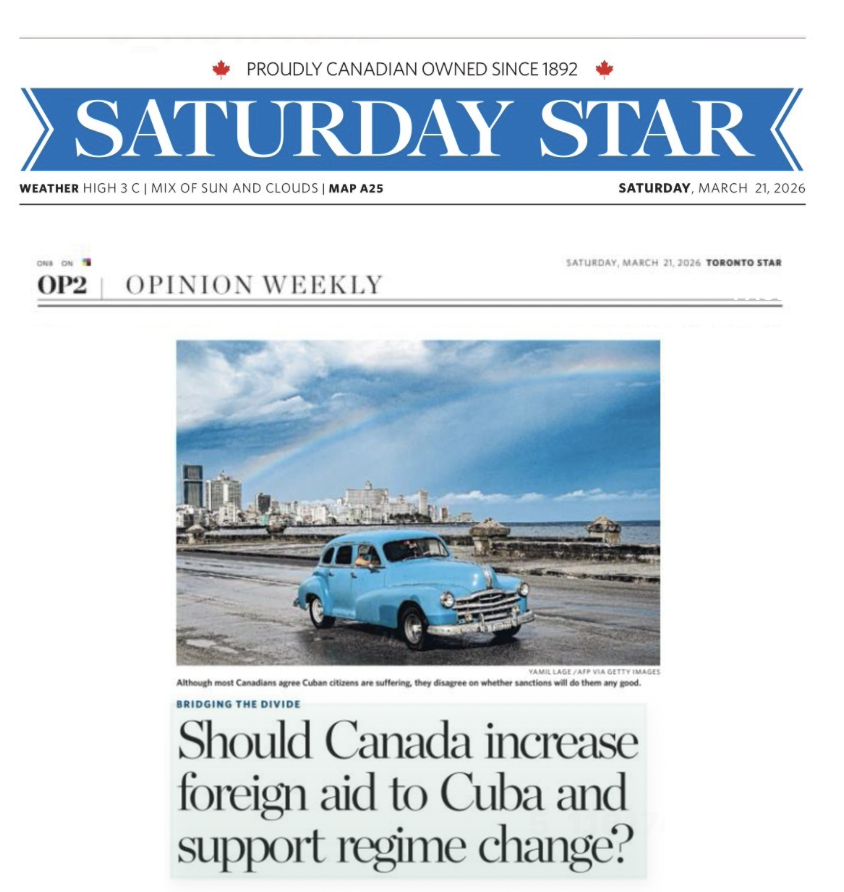
Michael Lima in the Toronto Star Debate: A Call for Canada to Confront the Reality of Cuba
On March 21, 2026, the Toronto Star published a debate on Canada’s policy toward Cuba at a moment of deepening crisis on the island. Among the contributors was Michael Lima, Director of Democratic Spaces, who offered a clear and uncompromising argument rooted in human rights and democratic accountability. His intervention stands out for insisting that Canada move beyond long held assumptions and confront the political nature of Cuba’s crisis.
Lima’s central claim is that the situation in Cuba cannot be understood as a humanitarian emergency alone. While shortages of food, medicine, and basic services are undeniable, he argues that these are symptoms of a deeper and more structural problem. In his view, Cuba is facing a systemic crisis caused by the nature of its political model. He describes current conditions as resembling those of a failed state, where the collapse of infrastructure and public services reflects decades of political and economic mismanagement.
What makes Lima’s perspective particularly striking is his emphasis on what Cubans themselves are demanding. He rejects the idea that the population is primarily calling for the lifting of sanctions. Instead, he points to a consistent message emerging from protests and everyday conversations across the island. Cubans are demanding freedom, democracy, and an end to dictatorship. For Lima, this distinction is essential because it challenges narratives that frame the crisis as externally driven rather than rooted in the system itself.
A core part of his argument focuses on the scale of political repression. Lima highlights that more than one thousand people remain imprisoned for exercising fundamental rights. He describes conditions in Cuban prisons as severe, with detainees subjected to violence, denial of medical care, and prolonged isolation. These realities, he argues, are not peripheral but central to understanding the Cuban state.
Beyond the prison system, Lima portrays a society marked by what he calls civic and political defenselessness. Citizens cannot freely choose their government, independent media is absent, and civil society organizations cannot operate legally. Economic life is also tightly controlled, with the state as the dominant employer, leaving individuals with limited autonomy. In this context, he argues that humanitarian aid, while necessary, cannot resolve the crisis on its own because it operates within a system that restricts freedom and controls distribution.
Lima is also sharply critical of Canada’s longstanding policy of constructive engagement with Cuba. For decades, Canada has maintained diplomatic ties and provided assistance in the hope of encouraging gradual reform. According to Lima, this approach has failed. Not only has it not produced meaningful political change, but it has also coincided with an increase in political prisoners and closer ties between Cuba and other authoritarian governments. He suggests that Canada’s policy has been inconsistent with its stated commitment to democracy and human rights.
In place of this approach, Lima calls for a policy grounded in transparency, accountability, and consistency. He argues that humanitarian assistance should be delivered with safeguards to ensure it reaches the population rather than reinforcing state control. He also urges Canada to call for the release of political prisoners and to press for international oversight of prison conditions, including access for the International Committee of the Red Cross.
At the same time, Lima advocates for stronger engagement with Cuban civil society. He believes Canada should support the legalization of independent organizations and pro democracy groups and use its diplomatic presence to engage directly with human rights defenders on the island. He also raises the need to reassess the presence of Cuban state media in Canada, arguing that it forms part of a broader system of control and narrative management.
On the question of sanctions, Lima offers a nuanced position that challenges common assumptions. He rejects the idea that sanctions are the root cause of Cuba’s crisis, arguing instead that the system itself has produced decades of economic failure and repression. At the same time, he distinguishes between broad economic measures and targeted sanctions. He supports the use of Magnitsky style sanctions aimed at individuals responsible for human rights abuses, which he sees as both legitimate and consistent with Canada’s actions in other contexts.
Underlying all of Lima’s arguments is a fundamental premise. The humanitarian crisis in Cuba cannot be resolved without political change. He maintains that no amount of aid will be sufficient if the system that generates the crisis remains intact. Real progress, in his view, requires that Cubans be able to freely choose their political system, exercise their rights, and hold their leaders accountable.
Lima’s contribution to the Toronto Star debate ultimately serves as a call for Canada to reassess its role. He urges policymakers to align their actions with the values they claim to defend and to recognize that the aspirations of the Cuban people go beyond immediate relief. They are calling for freedom.
As Cuba’s crisis deepens and international attention grows, Lima’s message is clear. Canada will face a defining choice. It can continue a policy that has produced limited results, or it can take a principled stand that places human rights and democratic change at the center of its approach.