Maduro and Cilia Flores Charged with Torture: A Historic Step Toward Justice for Venezuela’s Victims
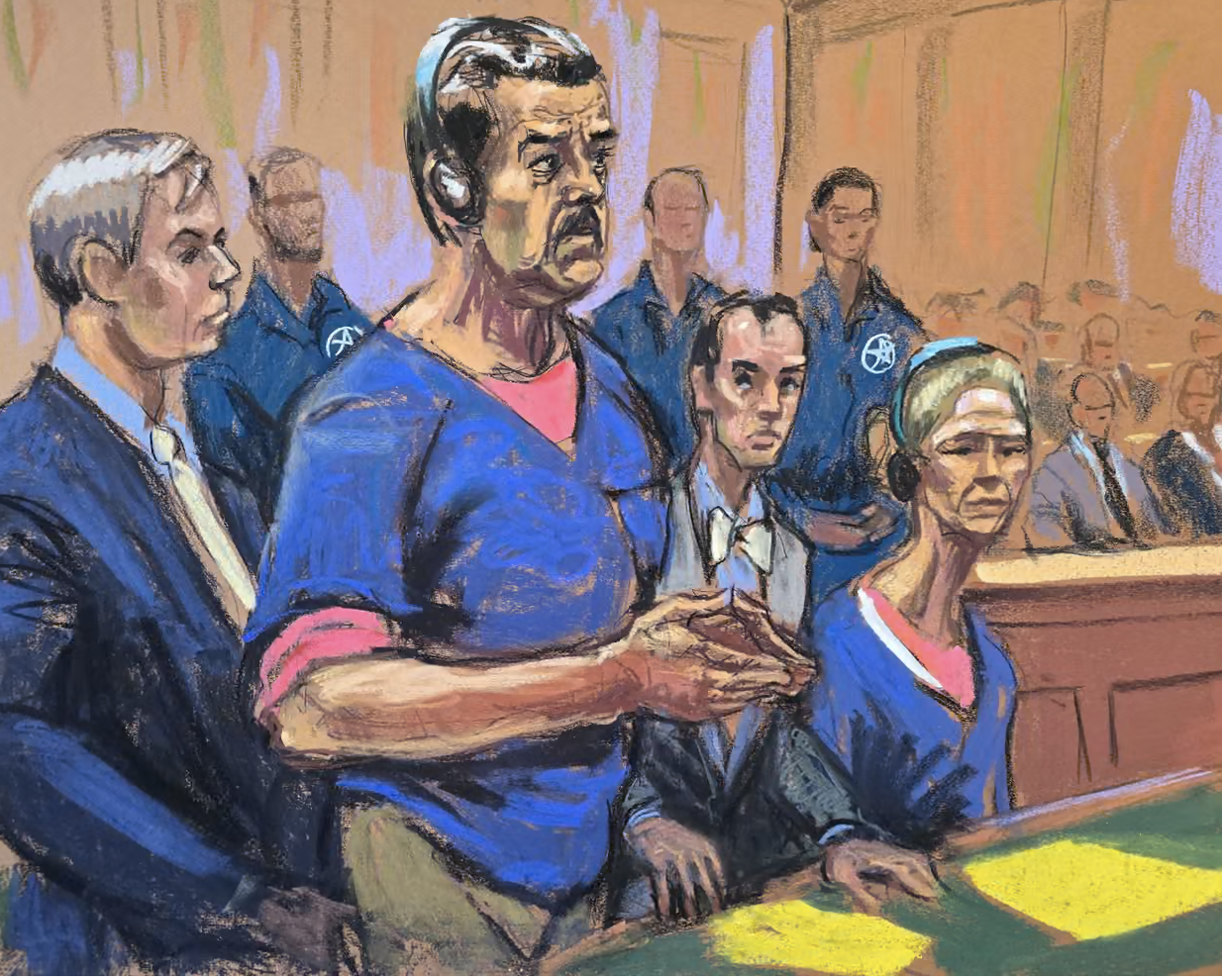
A courtroom sketch shows Nicolás Maduro and Cilia Flores during their arraignment in a New York City courtroom in January 2026. Photograph: Jane Rosenberg/AFP/Getty Images/The Guardian
October 8, 2026 | Democratic Spaces
October 8, 2026, will be remembered as a historic day in the long struggle for justice by the victims of political repression in Venezuela. For the first time, former Venezuelan ruler Nicolás Maduro and his wife, Cilia Flores, face federal criminal charges in the United States specifically alleging their participation in a conspiracy to commit torture.
A superseding indictment unsealed in Manhattan federal court accuses the couple of overseeing and facilitating a system of repression built on political persecution, arbitrary detention, torture, and violence. The charges include the alleged torture of American citizens imprisoned in Venezuela.
According to the U.S. Department of Justice, Maduro, Flores, and other Venezuelan leaders allegedly used their control over the military, judiciary, intelligence services, and law enforcement institutions to enrich themselves, suppress political opposition, and maintain their grip on power.
The indictment represents a potentially historic step toward accountability for abuses committed under a regime whose systematic violations of human rights have been documented for years by United Nations investigators and international human rights organizations.
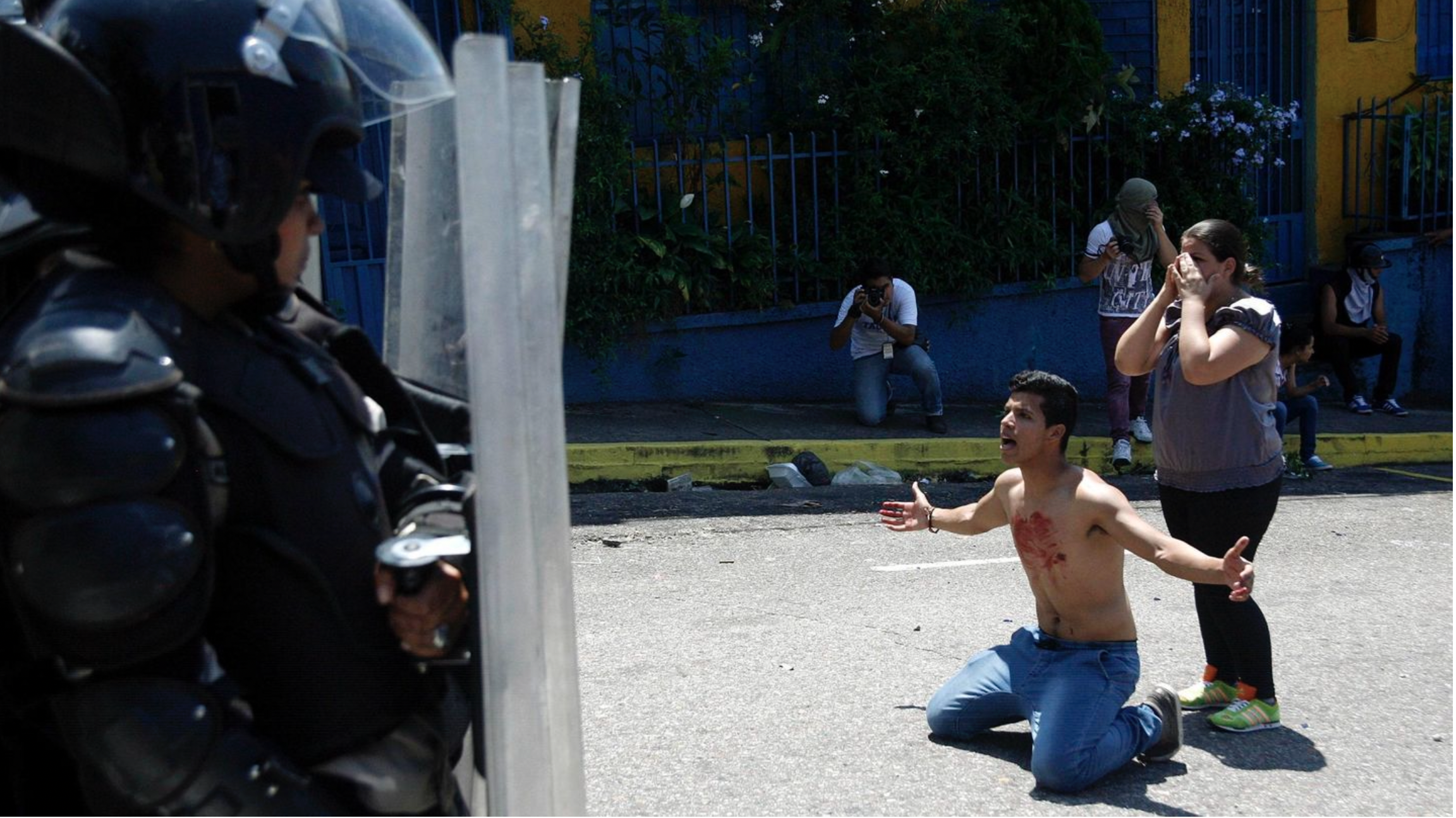
A young man with blood on his chest kneels before police following the death of Kluiver Roa during a protest in San Cristóbal, Venezuela. Roa was one of the many victims of the Maduro regime. He was just 14 years old when he died in hospital after being shot in the head, allegedly by officers of the Bolivarian National Police (PNB) who were suppressing a student protest at the Catholic University of Táchira (UCAT) in February 2015.
Photograph: Reuters/El Confidencial
The Horrifying Testimonies of American Torture Victims
The new indictment provides disturbing accounts of torture allegedly inflicted on United States citizens detained by Venezuelan authorities.
As reported by The Guardian on October 8, one American detainee described being deprived of food and water, subjected to simulated drowning, repeatedly beaten, electrocuted on his testicles, and forcibly injected with substances.
The psychological torture was equally horrifying.
According to the court documents cited by The Guardian, interrogators threatened to kidnap and rape the detainee's daughter unless he confessed and identified alleged accomplices. On one occasion, they allegedly displayed women's underwear and claimed it belonged to his daughter.
These allegations expose the calculated cruelty of a repressive system in which torture was allegedly employed not only to extract confessions but also to destroy prisoners psychologically by exploiting their deepest fears and threatening their families.
Even more disturbing are allegations concerning Maduro's personal involvement.
According to The Wall Street Journal, prosecutors allege that Maduro received updates about the torture of particular prisoners and sometimes suggested methods of abuse, including sleep deprivation and pouring water on detainees. The indictment further alleges that he sometimes laughed after hearing reports of their suffering.
These accusations raise fundamental questions about responsibility at the highest levels of political power. They describe not merely abuses by individual interrogators but an alleged system in which torture was tolerated, encouraged, and, in certain instances, personally directed by those at the top of the chain of command.
Nearly Thirteen Years of Repression and Crimes Against Humanity
From Maduro's assumption of the presidency in 2013 until his capture by U.S. forces on January 3, 2026, Venezuela experienced nearly thirteen years of increasingly authoritarian rule, political persecution, and institutional deterioration.
The scale of repression is staggering.
According to the Venezuelan human rights organization Foro Penal, more than 18,600 politically motivated arrests were recorded between 2014 and December 2025. These arrests were part of a broader pattern of criminalizing dissent, imprisoning opposition activists, and intimidating those who challenged the government.
United Nations investigators have documented widespread arbitrary detention, torture, sexual violence, enforced disappearances, and extrajudicial killings.
In September 2020, the United Nations Independent International Fact-Finding Mission on Venezuela concluded that there were reasonable grounds to believe that Venezuelan authorities and security forces had committed crimes against humanity. Its investigations examined thousands of deaths associated with security operations and documented patterns of state violence.
The Mission's September 2022 report further examined systematic torture and other abuses, including electric shocks, sexual violence, asphyxiation, and severe psychological mistreatment. Furthermore, former Venezuelan political prisoners have testified that they identified Cuban nationals among those involved in torture sessions by their distinctive accents.
“Former DGCIM officials told U.N the Mission that Cuban State agents have instructed, advised and participated in intelligence and counter-intelligence activities with DGCIM.”
Michael Lima, Dir of Democratic Spaces in Martí Noticias on December 28, 2022 discussing Cuba-Venezuela cooperation. "Since the signing of the Comprehensive Cooperation Agreement in 2002 to this date, the relationship between Cuba and Venezuela has been one of interdependence for the survival and maintenance of both dictatorships. Terror as a form of government and hunger as a weapon of social control have been two of the most significant contributions of the Cuban dictatorship to the Venezuelan regime. Desde la firma del Acuerdo Integral de Cooperación en 2002 hasta la fecha, la relación entre Cuba y Venezuela ha sido de interdependencia para la supervivencia y mantenimiento de ambas dictaduras. El terror como forma de gobierno y el hambre como arma de control social han sido dos de los aportes más significativos de la dictadura cubana al régimen venezolano.
Subsequent UN investigations have identified patterns of repression involving Venezuela's intelligence services and security forces, raising questions about responsibility extending through the institutional chain of command to the country's highest political authorities.
The regime's repression was accompanied by an unprecedented humanitarian and migration crisis. By late 2025, approximately 7.9 million Venezuelan refugees and migrants were living outside their country, including more than one million people seeking international protection.
These figures represent millions of individual tragedies: families separated, livelihoods destroyed, political prisoners deprived of their freedom, and victims who have waited years for recognition and justice.
The Destruction of Electoral Democracy
Political repression cannot be separated from the systematic dismantling of democratic institutions in Venezuela.
Maduro and his predecessor, Hugo Chávez, consolidated control over key state institutions, including the electoral authorities, judiciary, and security apparatus.
The disputed presidential election of July 28, 2024, exposed the depth of this institutional crisis.
The opposition, led by María Corina Machado and represented on the ballot by Edmundo González Urrutia, collected and published polling-station tally sheets indicating that González had won a decisive majority of the vote.
Despite this evidence, the government-controlled National Electoral Council declared Maduro the winner without publishing the comprehensive, independently verifiable results necessary to substantiate its announcement.
Governments including Canada, the United States, the United Kingdom, and several European and Latin American countries rejected or refused to recognize the official result as a credible demonstration of Maduro's electoral victory and “denounced the lack of democratic legitimacy of the purported inauguration of Nicolas Maduro as president of Venezuela.”
The legitimacy of his continued claim to the presidency therefore remains central to the political context of the case, even though the criminal court must determine the charges on their legal merits.
Justice Must Extend Beyond American Victims
Although the new U.S. indictment gives particular attention to the torture of American citizens, its significance extends far beyond the nationality of the victims named in the proceedings.
For Venezuelans who endured imprisonment, torture, sexual violence, political persecution, and the disappearance or killing of loved ones, the indictment offers an important opportunity for international recognition of the system of repression under which they suffered.
American victims deserve justice. So do Venezuelan victims.
The allegations concerning the personal involvement of Maduro and Flores are especially consequential because accountability for state torture must not end with the prison guards, interrogators, and security officers who physically carry out abuses.
It must also examine those who designed, authorized, facilitated, or knowingly sustained the machinery of repression.
At the same time, the U.S. prosecution is not a comprehensive trial of every crime against humanity documented in Venezuela. The specific charge is conspiracy to commit torture, and the defendants retain the presumption of innocence unless proven guilty beyond a reasonable doubt.
The broader pursuit of justice must therefore continue through independent investigations, national courts exercising lawful jurisdiction, and international accountability mechanisms, including the International Criminal Court.
When Former Rulers Face Justice
The prosecution of Maduro and Flores belongs within a wider historical struggle to hold former autocrats accountable for grave human rights violations.
Former Chadian dictator Hissène Habré was convicted in 2016 of crimes against humanity, war crimes, and torture and sentenced to life imprisonment.
Former Liberian president Charles Taylor was convicted in 2012 of aiding and abetting war crimes and crimes against humanity committed in Sierra Leone and sentenced to 50 years in prison.
Former Khmer Rouge leader Khieu Samphan was convicted of crimes against humanity and genocide in proceedings before the Extraordinary Chambers in the Courts of Cambodia.
Other cases demonstrate both the possibilities and limitations of international justice. Slobodan Milošević died before his trial concluded. Guatemala's Efraín Ríos Montt was convicted of genocide in 2013, but the judgment was subsequently annulled. Former Ivorian president Laurent Gbagbo was acquitted of crimes against humanity.
These cases demonstrate that prosecutions do not guarantee convictions, but they challenge the assumption that former rulers are necessarily beyond the reach of judicial accountability.
October 8: A Historic Day for Venezuela's Victims
The October 8 indictment is significant not simply because a former ruler faces new criminal charges, but because it places allegations of torture and the responsibility of those who allegedly directed it at the centre of judicial proceedings.
The prosecution could provide an important opportunity to examine how a repressive state apparatus functioned, how its institutions cooperated, and how political leaders allegedly exercised control over the treatment of prisoners.
For the victims of Maduro's repression, the importance of this moment cannot be measured solely by the outcome of one criminal trial.
Their testimonies, suffering, and demands for justice must remain central to any process of democratic reconstruction in Venezuela.
Torture is not an instrument of legitimate government. Political imprisonment is not an acceptable means of preserving power. And no political leader should enjoy impunity for ordering, facilitating, or knowingly sustaining crimes against the people they govern.
October 8, 2026, may ultimately be remembered as a turning point in the pursuit of accountability for Venezuela's victims.
Justice, however, will remain incomplete as long as the Venezuelan dictatorship, led by Delcy Rodríguez and Jorge Rodríguez, alongside other senior figures of the regime, including Diosdado Cabello, remains in power, and until democracy and the rule of law are restored, fulfilling the aspirations of generations of Venezuelan students, pro-democracy demonstrators, and human rights activists who have struggled for freedom and democratic change over the past 26 years.