Sanctions as a Legitimate Tool Against the Global Culture of Impunity
Sanctions as a Legitimate Tool Against the Global Culture of Impunity
By Michael Lima | DEMOCRATIC SPACES November 18, 2026
A recent example of how authoritarian regimes seek to perpetuate a global culture of impunity in the international diplomatic arena is draft resolution A/C.3/81/L.30, concerning human rights and unilateral coercive measures, introduced by Cuba and Brazil before the Third Committee of the United Nations General Assembly. The draft resolution was adopted in November 2026 by 117 votes in favour, 56 against, and 4 abstentions. Leading democracies, including Canada, the United States, the United Kingdom, France, Denmark, Finland, Sweden, Switzerland, and European Union member states, opposed the resolution, reaffirming their support for sanctions as a valid, necessary, and legitimate instrument of international relations.
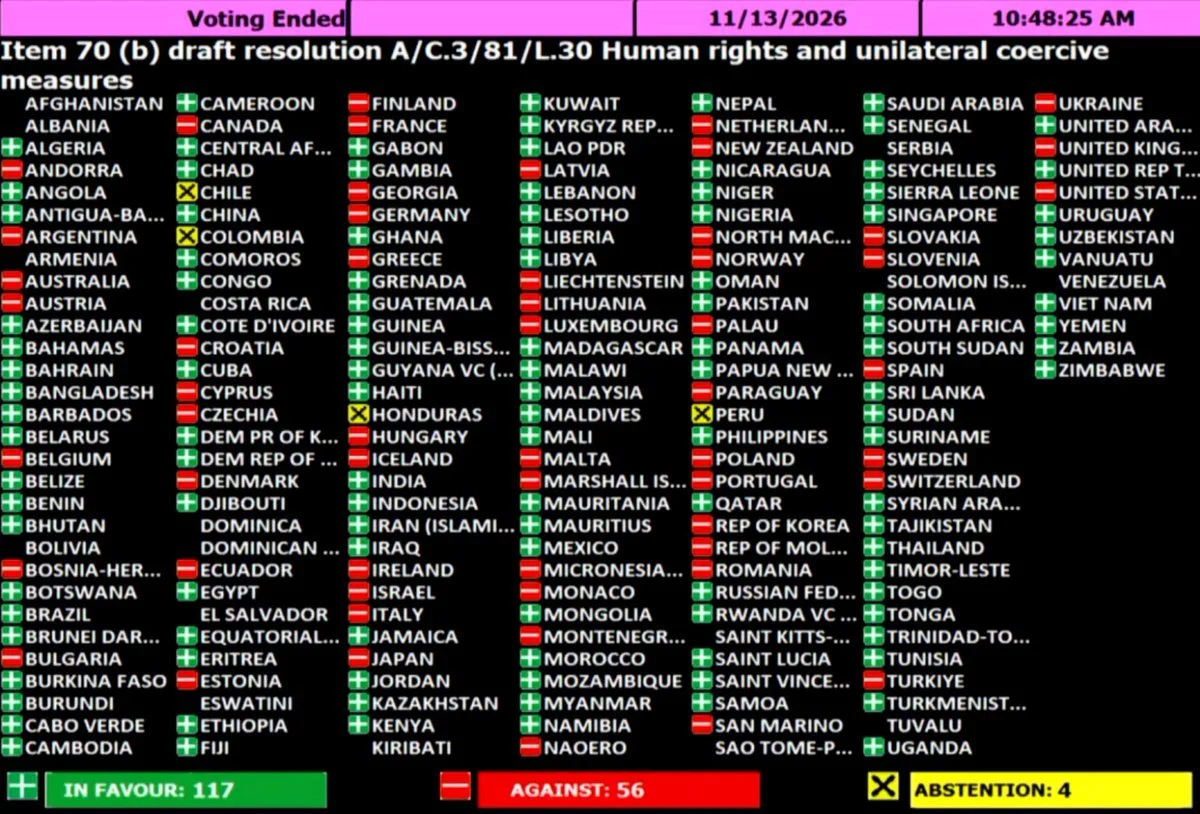
Screenshot of the voting results showing the UN General Assembly’s Third Committee approving draft resolution A/C.3/81/L.30 on human rights and unilateral coercive measures. November 16. 2026
For the past several years, Democratic Spaces along with other organizations such as the Human Rights Action Group has examined, through op-eds and research reports, the many ways in which authoritarian regimes such as Cuba cooperate with Russia, China, Iran, and other countries to advance their shared interests through asymmetric warfare, disinformation campaigns, and the exchange of repressive methods. Such cooperation also helps foster a global culture of impunity, sustained not only through alliances among autocracies and hybrid regimes, but also, at times, through the complicity of democratic governments.
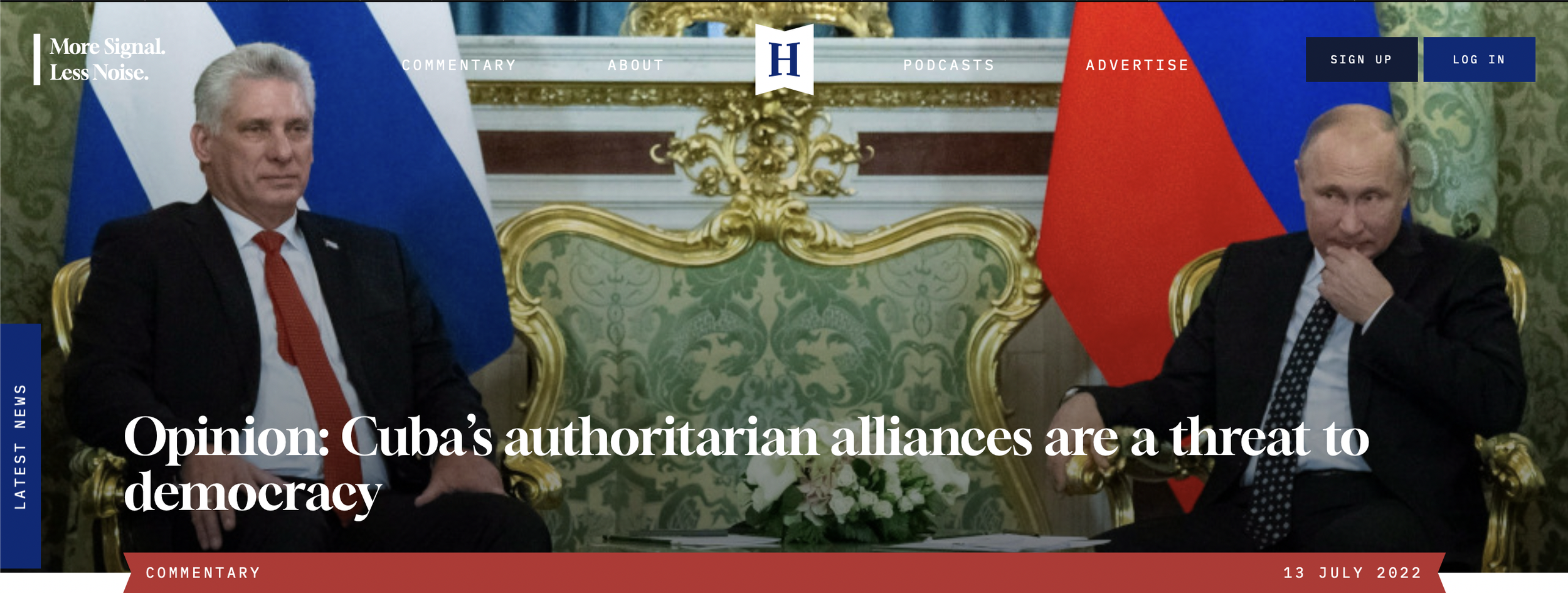
For example, a report by CADAL found that between 2008 and 2020, the Cuban regime voted 74 times against the adoption of resolutions addressing serious human rights concerns in countries such as North Korea, Syria, Iran, and others. This voting record illustrates how authoritarian governments can use multilateral institutions to shield one another from international scrutiny and undermine efforts to hold perpetrators of serious human rights violations accountable.
In effect, the resolution seeks to delegitimize the use of unilateral sanctions, including measures that democratic governments may employ to hold authoritarian regimes and their officials accountable for serious human rights violations. Such initiatives risk undermining international efforts to combat impunity.
In a world marked by expanding authoritarianism, targeted sanctions remain a legitimate instrument of international relations for holding individuals accountable for gross human rights violations against their own populations. Sanctions also provide a means of responding to regimes that sponsor international terrorism, such as Iran, or wage wars of aggression against sovereign states, as Russia has done under Vladimir Putin through its invasion of Ukraine.
Historically, sanctions have been imposed on military dictatorships in the Americas during the 1970s and against South Africa's apartheid regime. These precedents demonstrate that sanctions have long formed part of the international community's response to systematic human rights violations and grave breaches of international norms.
As of October 2025, Canada had imposed targeted sanctions on 80 individuals from seven jurisdictions under the Justice for Victims of Corrupt Foreign Officials Act, commonly known as Canada's Magnitsky Law. Canada has also imposed sanctions relating to more than 26 countries and jurisdictions worldwide, including Russia, China, Iran, Belarus, Nicaragua, and Venezuela, under various legal frameworks, including the United Nations Act (UNA) and the Special Economic Measures Act (SEMA).
In light of this record, it is puzzling that while democracies such as Canada recognize the legitimacy of sanctions and have imposed them on authoritarian regimes and their officials around the world, Global Affairs Canada has yet to act on Democratic Spaces' repeated calls to impose targeted sanctions on members of Cuba's repressive apparatus responsible for widespread political persecution, torture, killings, and other gross human rights violations.
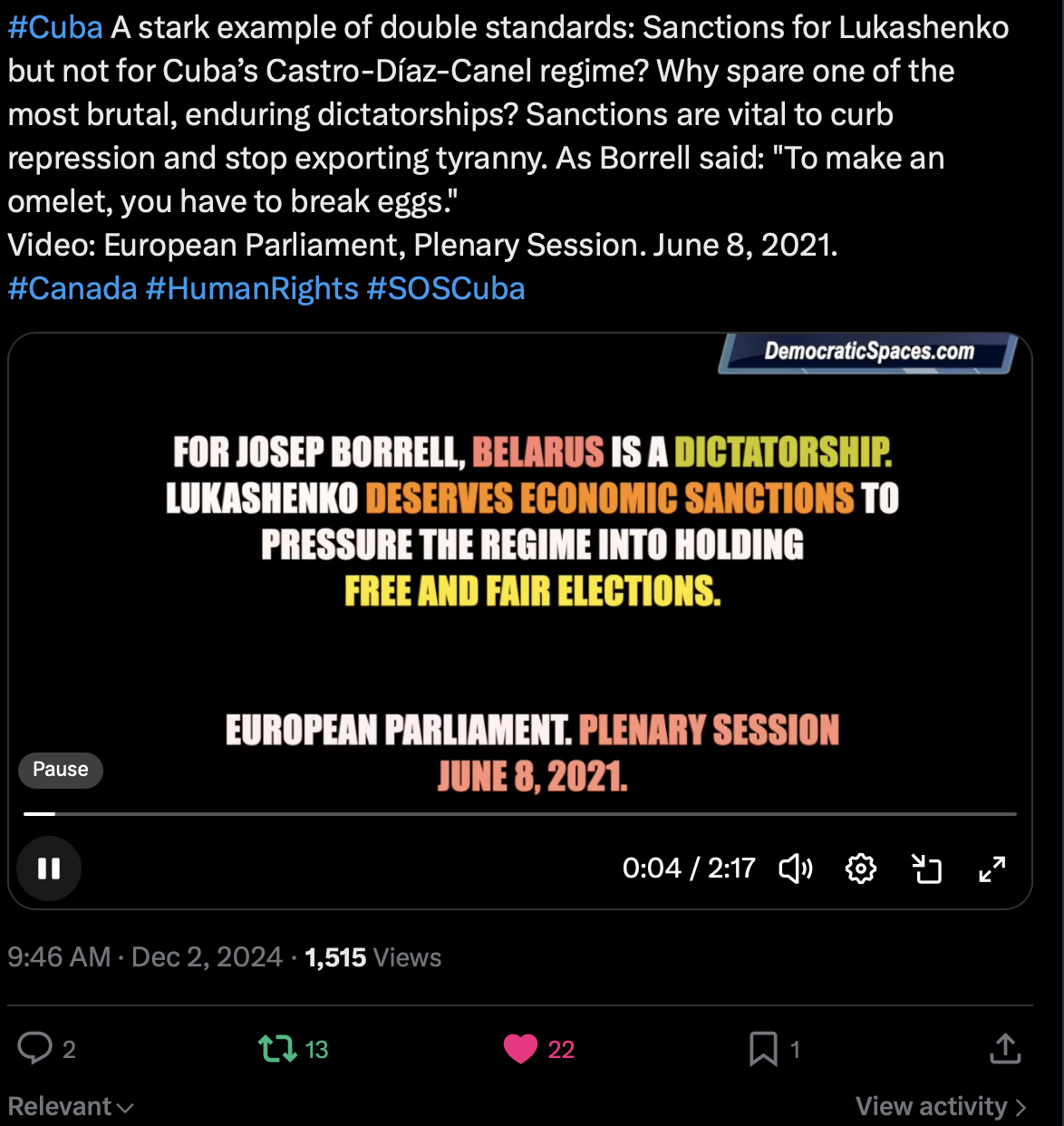
A stark example of double standards: Josep Borrell calls for sanctions on the Lukashenko dictatorship in Belarus but not for Cuba’s Castro-Díaz-Canel regime? Why spare one of the most brutal, enduring dictatorships? Sanctions are vital to curb repression and stop exporting tyranny. As Borrell said: "To make an omelet, you have to break eggs." Video: European Parliament, Plenary Session. June 8, 2021.
At a time when authoritarian regimes increasingly cooperate to foster a global culture of impunity for atrocity crimes, we call on Canada to demonstrate consistency between its stated foreign policy principles and its actions by imposing targeted sanctions on Cuban officials responsible for these abuses. We also urge the international community to recognize and support targeted sanctions as a legitimate and necessary instrument of international diplomacy.
Sanctions provide democracies with legal, political, and diplomatic tools to hold authoritarian regimes accountable without resorting to military intervention. They offer a peaceful means of responding to governments that massacre their own populations, torture citizens for exercising their fundamental human rights, sponsor international terrorism, or wage wars of aggression against sovereign nations. Rather than allowing perpetrators to act with impunity, democracies must make clear that grave human rights violations carry consequences.