Cuba’s Crisis and the Risk of Authoritarian Succession
Cuba’s Perfect Storm Could Still Lead to Another Authoritarian Succession
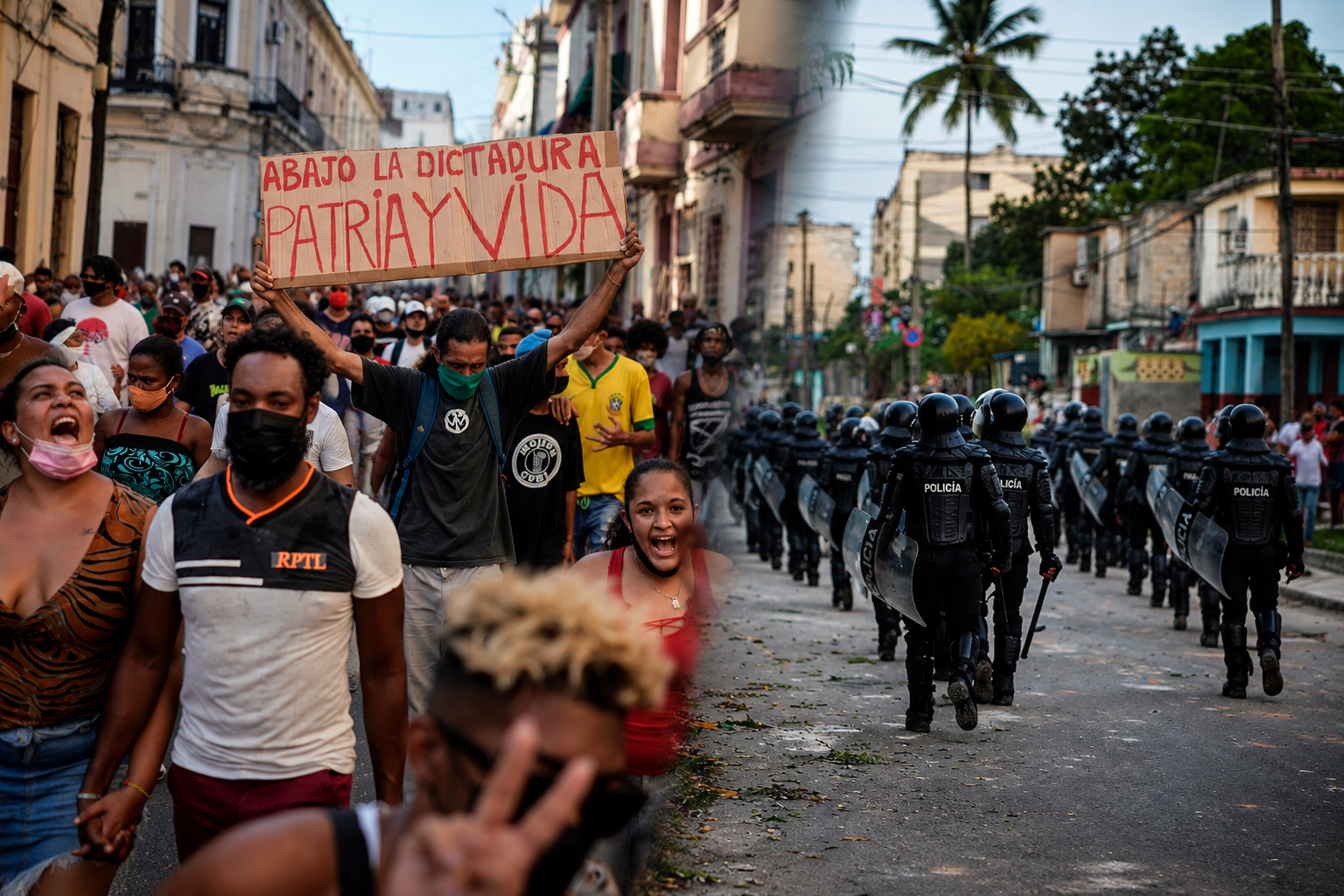
Merged images: Pro-democracy protests in Cuba on July 11, 2021 (left); riot police patrol the streets following anti-government demonstrations in Arroyo Naranjo, Havana (right). Photo: Yamil Lage/AFP/Getty Images.
By Michael Lima | DEMOCRATIC SPACES | September 14, 2026
This article originally appeared in Spanish in Diario Las Américas.
For the first time in decades, the Cuban regime faces a perfect storm: a prolonged economic collapse, sustained nonviolent civic resistance, the loss of reliable external support, and renewed pressure from the United States. These forces have weakened its political, economic, and geopolitical foundations.
But a crisis does not guarantee democracy. It can also lead to an authoritarian succession, in which elites preserve power through economic adjustments, new public faces, or the transfer of state assets to regime-linked actors.
The post-communist experience of the 1990s offers a warning. While the Baltic states consolidated democracy, Russia’s transition produced an oligarchy closely tied to state power. In Nicaragua, after losing the 1990 elections, Sandinista leaders transferred public assets to party-linked interests, preserving a base of power that facilitated Daniel Ortega’s eventual return.
Cuba faces a comparable danger. Commenting on the 176 economic measures announced by the government, economist Pavel Vidal warned that an economic opening without a political opening could transfer profitable state assets to well-connected individuals and lay the foundations for a new authoritarian order.
Rather than predicting the outcome of Cuba’s crisis, this analysis seeks to identify the forces and scenarios that could shape it: a democratic transition based on pluralism, human rights, and free elections, or a reconfigured authoritarian system under a new elite that retains control over political power and the nation’s wealth.
Unpopularity, Civic Resistance, and the Conditions for a Democratic Transition
The Cuban regime is experiencing one of its most unpopular periods in decades. Blackouts, shortages, inflation, deteriorating public services, and mass emigration have eroded daily life and expectations for the future.
Yet those who resist are demanding more than economic relief. Artists, students, independent journalists, human rights defenders, and civic activists are calling for fundamental freedoms, an end to political persecution, the release of political prisoners, and free and pluralistic elections. Cuba’s crisis is not merely economic; it is also political.
This aspiration is also reflected in public opinion. A recent survey of more than 42,000 Cubans inside and outside the island found that more than 94 percent reject the current system and more than 80 percent support a democratic model for Cuba.
As Michael McFaul argues, the outcome of a transition depends to a considerable extent on the ideas that guide the dominant actors: whether they view democracy as a framework of rules that must be respected or instead seek to preserve authoritarian power. In Cuba, many pro-democracy leaders have been imprisoned, exiled, or repressed, but continuing street protests demonstrate that democratic leadership continues to emerge in neighborhoods, universities, and religious communities.
Externally, Havana has lost the patrons that sustained the regime for decades: first the Soviet Union and later Venezuela, through subsidized oil and financial support. Today, Cuba faces its deepest economic crisis in decades without comparable backing.
Washington has intensified pressure through sanctions, greater scrutiny of foreign investment and financial transactions, and diplomatic measures that further constrain the Cuban economy. In recent months, investors in key sectors, including tourism and mining, have announced the suspension or reduction of operations, deepening uncertainty.
Moreover, the U.S.-led military operation in Venezuela on January 3, 2026, which resulted in the capture of Nicolás Maduro and Cilia Flores, deprived Havana of an ally that had sustained it with oil and other resources, further isolating the regime. Both were transferred to the United States to face charges of narco-terrorism, conspiracy to import cocaine, and weapons-related offenses before the U.S. District Court for the Southern District of New York.
Cuban Americans and other democracy advocates possess political and institutional resources that can support a democratic transition in Cuba. Their advocacy was instrumental in securing passage of the Cuban Liberty and Democratic Solidarity Act, commonly known as the Helms-Burton Act, which gave legal force to democratic principles and distinguished U.S. policy toward Cuba from its approach to other authoritarian regimes.
Because it is federal law, its core provisions cannot simply be altered or repealed by presidential decision. Helms-Burton establishes democratic conditions for the full normalization of relations between the United States and Cuba, including the release of political prisoners, respect for fundamental freedoms, and free, fair, multiparty elections. In doing so, it limits the possibility that superficial economic reforms or new faces in power can be presented as a democratic transition.
Cuban democracy advocates in exile have also articulated their own vision for a transition. The Liberation Accord is not a pact with the regime, but a roadmap calling for the unconditional release of political prisoners, the dismantling of the Communist Party’s monopoly and the institutions of repression, and free, fair, multiparty elections. Its purpose is to define the institutional transformations necessary for Cuba to begin a genuine democratic transition.
But Considerable Obstacles Remain
The principal obstacle is the cohesion of the coercive apparatus. The Revolutionary Armed Forces and the Ministry of the Interior have remained loyal despite economic collapse, widespread discontent, and repeated protests. Mass mobilization can become decisive when significant sectors of the security forces refuse to repress protesters or divisions emerge within the ruling elite. Cuba has yet to experience a rupture of this kind.
The regime has spent decades working to prevent such a rupture through surveillance, infiltration, harassment, imprisonment, exile, and the destruction of independent opposition organizations. It has also purged civilian officials, military officers, and Communist Party cadres considered disloyal or potentially autonomous. GAESA, the military-controlled business conglomerate, gives the ruling elite access to billions of dollars in offshore accounts, resources with which it can preserve loyalties, manage scarcity, and finance repression. Even an unpopular government can survive if it retains control over coercion, strategic sectors of the economy, and the institutions that distribute privileges.
This is crucial because, as studies of post-communist transitions demonstrate, whether a transition produces democracy or renewed authoritarianism depends on who commands greater political power during the transition and which actor succeeds in imposing its preferred institutional order. That power is measured both by the organizational strength and capacity for social mobilization of democratic forces and by the regime’s control of the state, access to resources, and coercive capabilities.
A Warning about the regime management model in Venezuela
Cuba is not Venezuela. Venezuela’s power structure is more fragmented, while the Cuban system remains centralized around Raúl Castro, his inner circle, and the institutions of the Revolutionary Armed Forces, the Ministry of the Interior, and the Communist Party. There is no equivalent of Delcy Rodríguez in Cuba.
Nevertheless, Venezuela offers an important lesson for advocates of Cuban democracy. The United States can exert considerable pressure on authoritarian regimes and has played a central role in defending democratic principles in the hemisphere. At the same time, Washington must reconcile those objectives with regional stability, migration, security cooperation, and economic recovery. When these immediate priorities take precedence over democratic guarantees, they can complicate the movement from an authoritarian crisis to a full democratic transition.
Venezuela has a domestic opposition led by María Corina Machado that used official tally sheets to document Edmundo González Urrutia’s victory in the July 2024 presidential election. The realities confronting Venezuela’s opposition and Cuba’s pro-democracy actors differ, shaped by their distinct institutional and repressive contexts. Nevertheless, Washington’s relationship with the government headed by Delcy Rodríguez, despite the absence of democratic guarantees and the continued existence of political prisoners, illustrates the difficulty of reconciling immediate governance challenges with the imperative of democratic restoration.
Cuba differs in one important respect: the Helms-Burton Act establishes legal conditions for the full normalization of relations between the United States and Cuba, including the release of political prisoners, respect for fundamental freedoms, and free, fair, multiparty elections. These provisions provide Cuban democracy advocates with a significant legal and political framework. The Venezuelan lesson, therefore, is not that U.S. support is absent, but that sustained political will is required to ensure that stabilization and reconstruction are accompanied by a genuine democratic transition.
Conclusion
The Venezuelan experience underscores a central lesson for Cuba: neither economic collapse, popular discontent, nor external pressure automatically produces democracy. The regime’s most likely strategy will be to buy time, preserve the system, and reject substantive reforms, hoping that external pressure will eventually weaken. That calculation depends on the loyalty of the coercive apparatus. Yet when sustained popular mobilization coincides with fractures within the armed forces, security services, or ruling elite, the political balance can shift rapidly.
Cuba may be approaching such a moment. But without greater capacity among democratic forces to shape events, the crisis could still culminate in another authoritarian succession, supported by a new class of wealthy, regime-connected oligarchs. The current window of opportunity is historically unusual. If it closes without meaningful political change, Cuba could face a more adaptable regime, a less favorable international environment, and an even more difficult path toward democracy.