Luis Manuel Otero Alcántara: The Cuban Artist the Regime Fears Most
Democratic Spaces Welcomes Cuban Artist Luis Manuel Otero Alcántara to Freedom While Condemning His Forced Exile
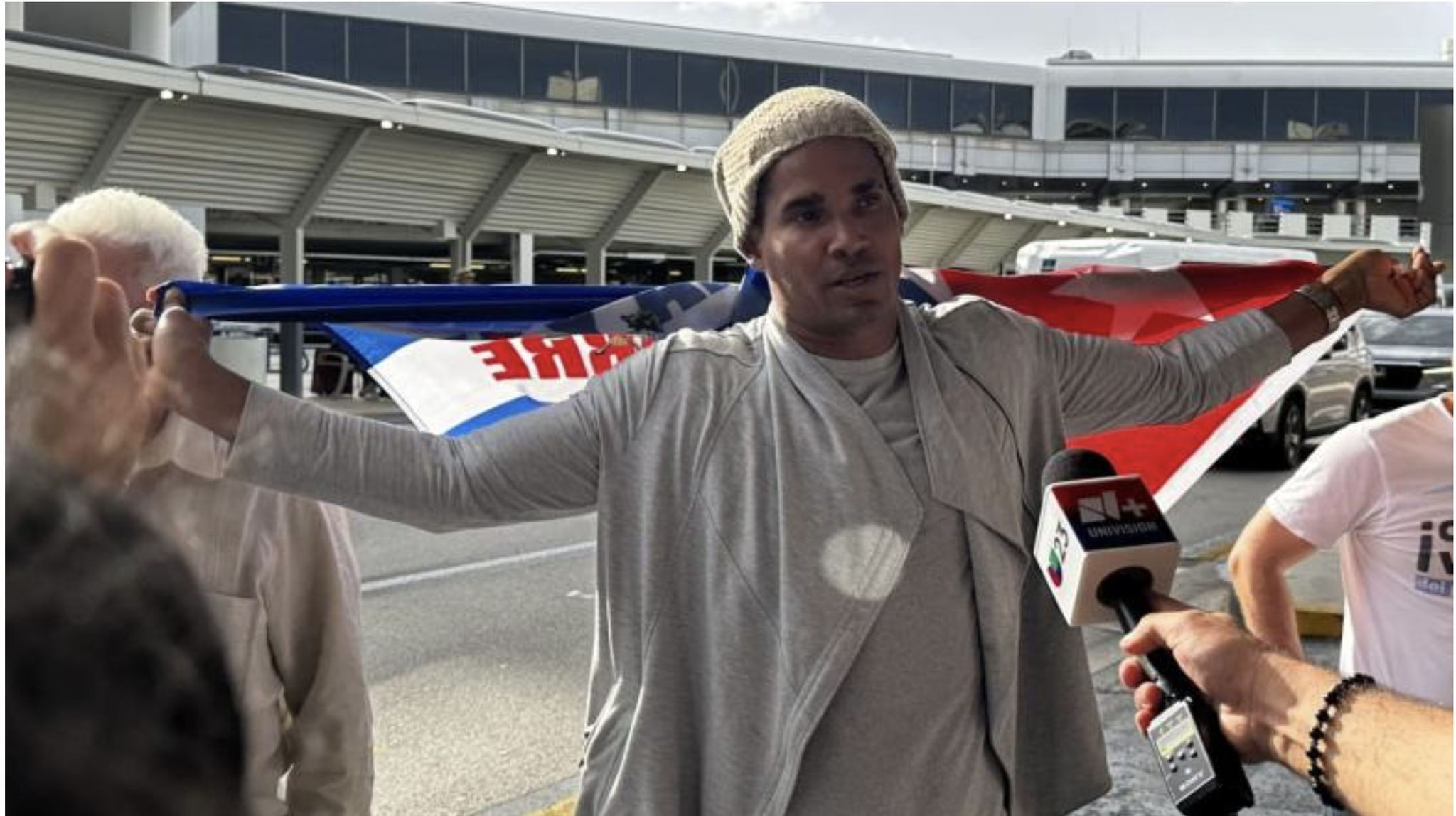
Photo: Coco Fusco. Miami International Airport, July 18, 2026.
Luis Manuel Otero Alcántara holds a Cuban flag bearing the words "Cuba Libre.” “Free Cuba.” In Cuba, he served five years in prison for an artistic performance involving the Cuban flag and was charged with ultraje a los símbolos patrios ("insulting national symbols") under Cuban laws that violate international human rights standards protecting freedom of expression. The Cuban flag belongs to all Cubans, not to the state or any political party.
MICHAEL LIMA CUADRA | JULY 18, 2026
ONTARIO, CANADA. July 18, 2026. Democratic Spaces welcomes the arrival of Cuban artist and pro-democracy activist Luis Manuel Otero Alcántara to the United States, where he can finally live in freedom after years of arbitrary imprisonment by Cuba's dictatorship.
At the same time, we unequivocally condemn both his politically motivated imprisonment and the forced exile imposed upon him, as well as the exile suffered by countless Cuban artists, activists, journalists, and human rights defenders. No one should be forced to choose between prison and exile for peacefully exercising fundamental freedoms.
By forcing one of Cuba's most celebrated dissident artists into exile, the Cuban regime has once again exposed its deepest fear: the power of art to mobilize dissent and the ability of a single individual to inspire democratic change.
From the day Luis Manuel Otero Alcántara was imprisoned, Democratic Spaces launched a global campaign calling for his immediate and unconditional release. Through publications, media interviews, advocacy meetings with civil society organizations and parliamentarians in Canada and abroad, and sustained campaigns across traditional and social media, we worked to keep his case visible and to rally international support for his freedom.
June 1, 2022. Michael Lima, Director of Democratic Spaces in Canada joins the global campaign calling for the immediate and unconditional release of Cuban artists and human rights defenders Luís Manuel Otero Alcántara and Maikel Osorbo as well as all Cuban political prisoners. Michael Lima, director de Democratic Spaces en Canadá, se une a la campaña mundial que pide la liberación inmediata e incondicional de los artistas y defensores de los derechos humanos cubanos Luís Manuel Otero Alcántara y Maikel Osorbo, así como de todos los presos políticos cubanos.
Today, more than ever, the arguments presented in our article, "The Cuban Artist the Regime Fears Most," have been vindicated. The article explains why Cuba's dictatorship fears the transformative power of art to awaken civic consciousness, mobilize peaceful resistance, and inspire democratic change through the courage of a single individual.
While we celebrate Luis Manuel's freedom, our thoughts remain with the more than one thousand Cuban political prisoners who continue to endure arbitrary detention, abuse, and persecution for peacefully exercising their fundamental rights. Democratic Spaces reiterates its call for the immediate and unconditional release of all political prisoners in Cuba and reaffirms its commitment to supporting the Cuban people's struggle for freedom, human rights, and democracy.
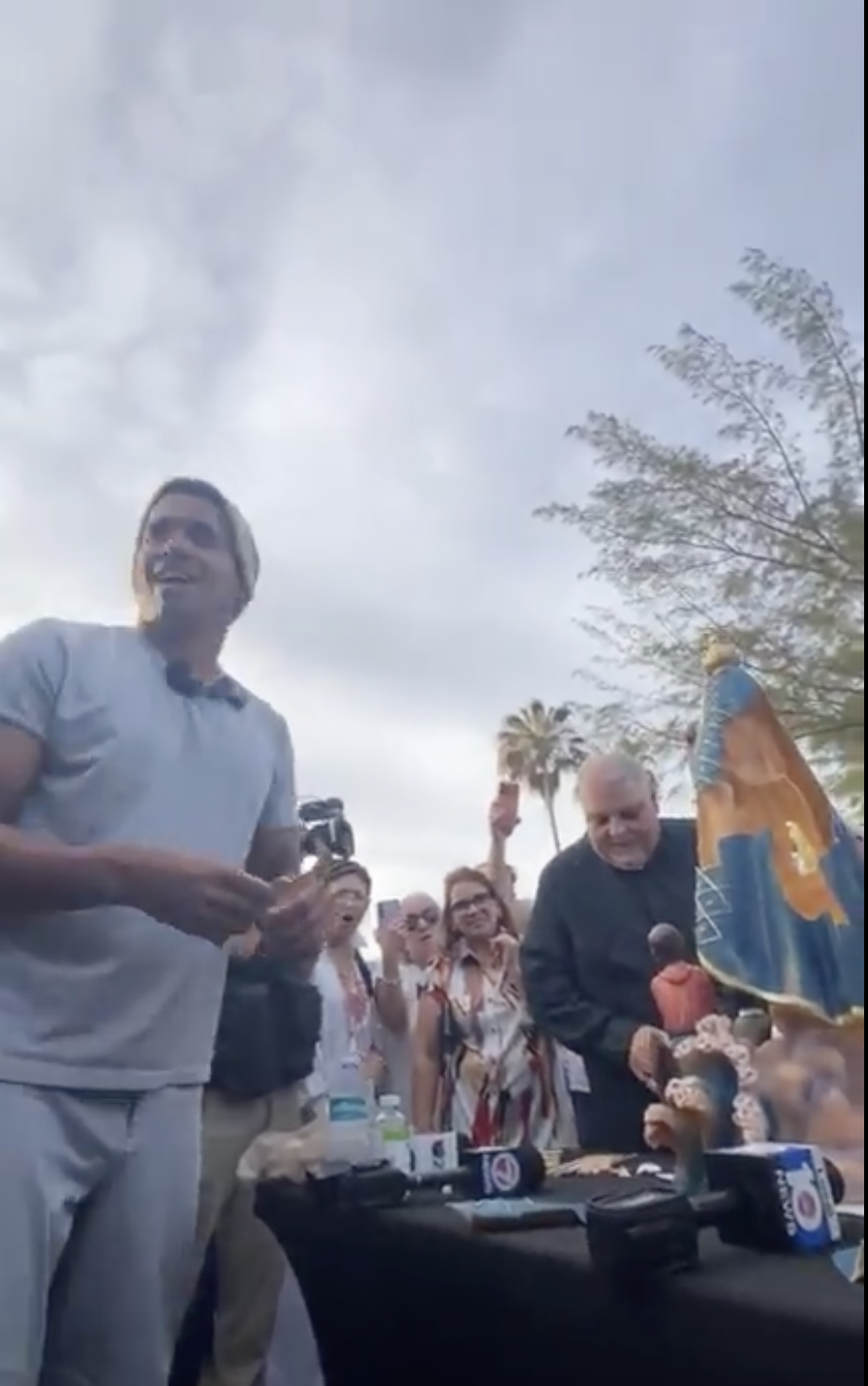
Miami, Florida. July 18, 2026. Luis Manuel Otero Alcántara brought a broken statue of Our Lady of Charity of El Cobre, Cuba's patron saint, from the island and reassembled it at Miami's Shrine of Our Lady of Charity in a moving tribute to Cuba's political prisoners. His gesture invites us to gather the scattered fragments, restore what has been broken, and believe that healing is still possible. May Our Lady of Charity protect the Cuban people, strengthen those who remain behind bars, and help freedom triumph. May Cuba, too, be restored, piece by piece and rise like the phoenix from the ashes of dictatorship.
This article originally appeared in Latinoamerica21. It was published alternatively in La Prensa (Panamá), Confidencial (Nicaragua/diaspora), Primicias(Ecuador), Metro (Puerto Rico), and Diario Las Américas (United States), La Patria(Bolivia), Tal Cual (Venezuela/diaspora), and Hoy (Dominican Republic) in English, Spanish, and Portuguese. The piece analyzes how the forced exile of Luis Manuel Otero Alcántara exposes the Cuban regime’s greatest fear: the transformative power of art and the ability of one individual to confront oppression and inspire a movement for freedom.
The Cuban Artist the Regime Fears Most
The forced exile of Luis Manuel Otero Alcántara reveals the Cuban regime’s major fear: the power of art and of a single individual to challenge repression and inspire freedom.
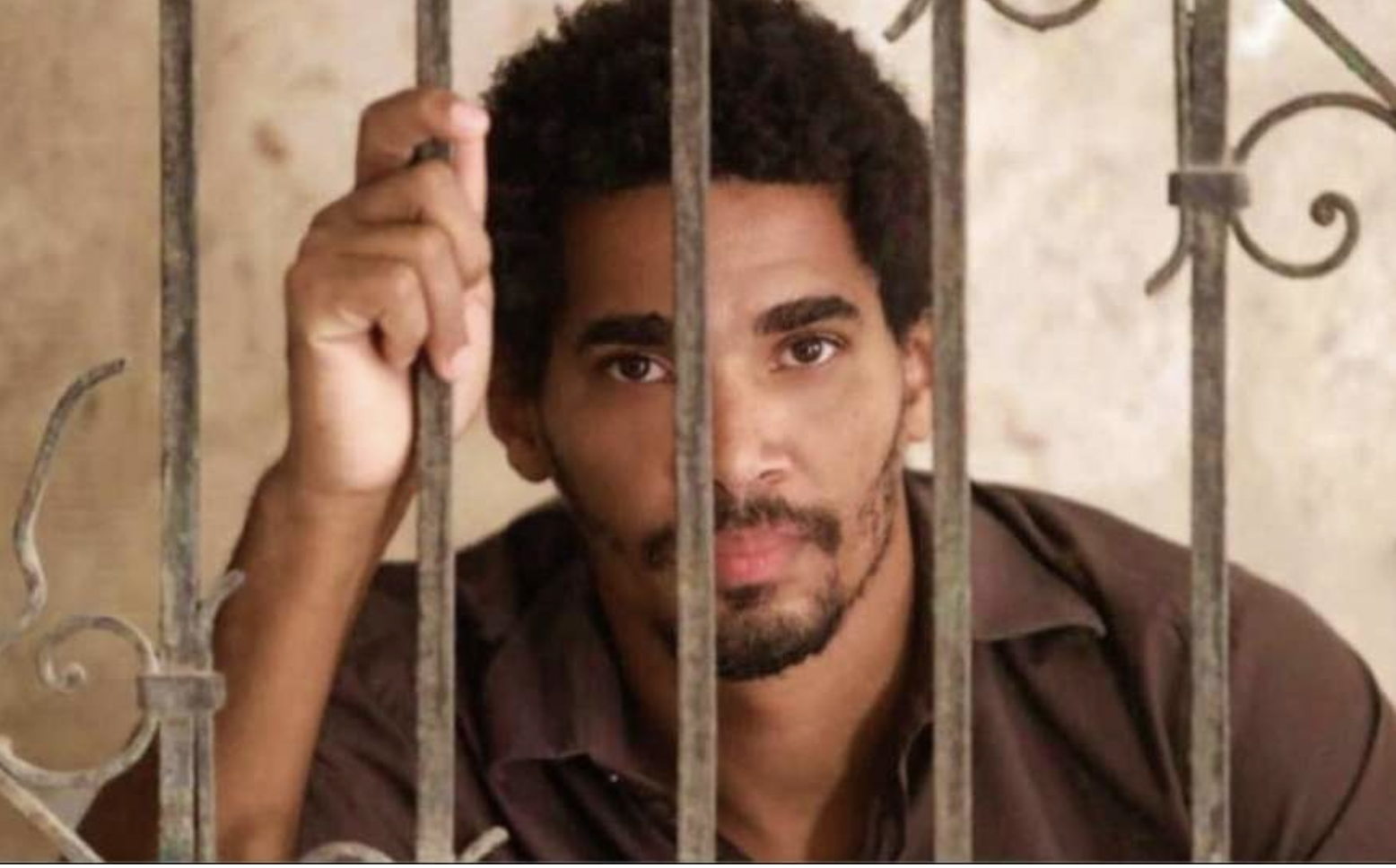
The Cuban regime is forcing one of its most celebrated dissident artists into exile, exposing its deepest fear: the power of art to mobilize dissent—and the power of the individual to inspire others for democratic change. Luis Manuel Otero Alcántara—named by Time in 2021 among the world’s 100 most influential people—embodies that threat. “I love freedom more than life itself,” he declared in 2020 after enduring dozens of arbitrary arrests—a credo that fuses his life, art, and activism. On July 11, 2021, he was arrested again as Cubans staged the largest protests in decades and later sentenced in a closed-door trial to five years in prison. From his cell, he warned: “They fabricated this five-year sentence out of nothing—out of falsehoods. They could invent another ten. So, I choose exile. But I don’t want to leave Cuba. My only options are martyrdom or exile.” His ordeal reveals how Havana weaponizes exile as punishment and erasure, silencing voices it cannot control.
Identity as Defiance
Otero embodies what the Cuban state fears most: the power of a poor, Black, self-taught artist who turned marginalization into resistance. His existence dismantles the official myth that the revolution was built by and for the poor and Afro-descendants.
In 1961, Fidel Castro invoked the murder of literacy teacher Conrado Benítez, declaring: “He was poor, he was Black, and he was a teacher. Those were the reasons why the agents of imperialism murdered him.” Today, in a cruel inversion, Otero is persecuted for those same reasons—not by imperialists, but by the Cuban state. Poor. Black. Dissident. For Havana’s poor neighborhoods, he has become a symbol of dignity, echoing the cry heard in the 1994 Maleconazo uprising and again on July 11, 2021: libertad.
Art as Resistance
Otero belongs to a long tradition of Cubans who carved out spaces beyond state control, turning culture into protest—and paying dearly through prison, with exile now looming as his next punishment. The regime fears him not only for who he is, but for his power to mobilize. He stands in a wider lineage of resistance—from underground poets in Czechoslovakia to artists in Nicaragua under Ortega and Ai Weiwei in China—proof that creativity can outlast repression.
His most enduring contribution—together with Yanelys Núñez, Maykel Castillo “El Osorbo,” and Amaury Pacheco—was founding the San Isidro Movement (MSI) in 2018. Born in defiance of Decree 349, which banned art without state approval, MSI launched a crusade against censorship andbroadened Cuba’s opposition by drawing in artists, intellectuals, feminists, LGBTQ+ activists, and others long excluded from dissent.
Symbolic actions soon defined the movement. In November 2020, MSI members staged a hunger strike to denounce the arrest of rapper Denis Solís, exposing the persecution of dissident artists. Months later, Otero’s performance Garrote Vil during the Communist Party Congress dramatized the suffocation of Cuban dissenters, using the iron collar once employed for executions under Spanish colonial rule and later Franco’s dictatorship to mirror how the state strangles opposition today.
This cultural explosion reached its peak with Patria y Vida, the Grammy-winning anthem that united Otero, Castillo, and Eliéxer Márquez “El Funky” with Cuban artists in the diaspora. Like Poland’s Solidarność banner in the 1980s or Hong Kong’s Umbrella Movement, the song became an unstoppable cry of defiance— proof of the symbolic power of art to shake a dictatorship more forcefully than any weapon.
By 2021, MSI had pushed Cuba’s repression into the global spotlight. The Washington Post ran dozens of articles about the movement between late 2020 and mid-2021, while solidarity actions spread across Europe and theAmericas—an eruption unseen in decades. Through inventive digitalresistance, MSI livestreamed hunger strikes, sit-ins, and police raids despite constant internet blackouts. Their motto—Estamos Conectados—captured both resilience and creativity, linking Cubans on the island with those abroad.
Habana, Cuba. Apri; 30, 2021. Luis Manuel Otero's health is at a critical state after 5 days in a hunger and thirst strike. This video is intended to urge the Government of Canada and democratic governments around the world, NGOs, institutions and people of good will to raise a voice in solidarity with Luis Manuel Otero and against the extreme repression he and other artists/activists are subjected in Cuba. Luis Manuel Otero Alcantara is a Cuban contemporary artist, co-founder of the Museum of Dissidence, human rights leader and coordinator of the San Isidro Movement. In protest for the State of Terror he and other artists and human rights activists have been subjected by the Cuban regime, he started a hunger and thirst strike on April 25. It is a measure of last resort against police sieges and forced house arrests on dozens of artists and activists across the island. In the past 3 years Luis Manuel Otero has been arbitrarily arrested over 48 times. Since Nov 2020 he has been the target of 24/7 police surveillance and on April 16, the regime stole his artworks and damaged it. Luis Manuel Otero Alcántara´s demand as a condition to end his hunger/thirst strike: 1- End the police siege, he has been under since November 2020 and the State of Siege that prevents the free movement of artists, journalists, and activists 2- Return of the art pieces stolen to Luis Manuel Otero Alcántara and offer him financial compensation for the damages incurred on his artwork. 3- Respect the full exercise of artistic freedoms for all Cuban artists.
Why He Terrifies Havana
Today, Cuba faces prolonged blackouts, poverty affecting more than 89% of households, and widespread frustration. According to the Cuban Observatory of Human Rights, public disapproval of the government reached 92% in its 2025 report, while the Cuban Observatory of Conflicts documented more than 6,000 civic protests so far in 2025—from students denouncing internet prices to communities demanding water andelectricity. In this climate, leaders like Otero are seen as especiallydangerous because they channel spontaneous discontent into organized resistance.
Although the San Isidro Movement was dismantled through arrests, forced exile, and travel bans, it endures as a blueprint for civic organization, digital strategy, and international solidarity.
The Voice They Cannot Banish
Otero’s imprisonment and looming exile mark a turning point in Cuba’s repressive strategy. Since July 2021, the regime has shifted from short detentions to long sentences and systematic banishment—tactics meant to erase civic leadership. Forced exile is both punishment and erasure, violating Cuba’s obligations under international law, including Article 12 of the International Covenant on Civil and Political Rights and Article 13 of the Universal Declaration of Human Rights.
Yet Otero’s legacy endures. He has shown that resistance can rise from ordinary Cubans—marginalized neighborhoods, Afro-descendant communities, the forgotten poor. The San Isidro Movement seeded a culture of protest, paved the way for July 11, and proved that art can carry repression onto the world stage. From prison, he organized symbolic fasts and created works later exhibited abroad. His resilience has been recognized worldwide, earning honors from ArtReview, the Rafto Prize, and the Václav Havel Prize.
Even in exile, Otero will remain a global voice, rallying solidarity across academia, the arts, and civil society. But true solidarity requires more than recognition: it calls for his unconditional release, an end to forced exile and re-entry bans, and the repeal of laws that criminalize art and dissent.
The persecution of a single artist—fabricated charges, a show trial, imprisonment, exile—does not show strength but weakness. Autocrats may command armies, yet they tremble before the courage and imagination of one individual who dares to inspire others.
On April 16, 2021 State Security agents violently and arbitrarily arrested contemporary cuban artists Luis Manuel Otero Alcántara and Afrik Reyna. Luis Manuel Otero´s artwork (a painting collection of candy wrappings and a Garrote Vil) were forcefully/arbitrarily removed from his home by police and badly damaged. Otero will therefore has stated its intention to sue the Cuban regime for $500,000 dollars over damages to his art.
Researcher and director of Espacios Democráticos, an NGO dedicated to promoting solidarity in Canada with human rights defenders and civil society in Cuba. Master in Latin American History from the University of Toronto
El artista cubano al que más teme el régimen
El exilio forzado de Luis Manuel Otero Alcántara revela el mayor temor del régimen cubano: el poder del arte y de un solo individuo para desafiar la represión e inspirar la libertad.
MICHAEL LIMA CUADRA
El régimen cubano obliga al exilio a uno de sus artistas disidentes más célebres, exponiendo así su mayor temor: el poder del arte para movilizar la disidencia y el poder del individuo para inspirar a otros a favor del cambio democrático. Luis Manuel Otero Alcántara, nombrado por Time en 2021 entre las 100 personas más influyentes del mundo, encarna esa amenaza. «Amo la libertad más que a la vida misma», declaró en 2020 tras sufrir decenas de arrestos arbitrarios, un credo que fusiona su vida, su arte y su activismo. El 11 de julio de 2021, fue arrestadode nuevo durante las protestas más grandes en décadas en Cuba y posteriormente condenado a cinco años de prisión en un juicio a puerta cerrada. Desde su celda, advirtió: “Fabricaron esta sentencia de cinco años de la nada, de falsedades. Podrían inventar otros diez. Así que elijo el exilio. Pero no quiero irme de Cuba. Mis únicas opciones son el martirio o el exilio”. Su calvario revela cómo La Habana utiliza el exilio como arma de castigo y opacidad, silenciando las voces que no puede controlar.
January 20, 2021. Video from Luis Manuel Otero Alcántara, presented in an event with Global Affairs Canada on January 19, 2021. . The video describes that Cuba is ruled by a dictatorship and exposes camera surveillance, persecution and harassment perpetrated against him and other independent artists and critics in Cuba
Identidad como desafío
Otero encarna lo que más teme el Estado cubano: el poder de un artista pobre, negro y autodidacta que convirtió la marginación en resistencia. Su existencia desmantela el mito oficial de que la revolución fue construida por y para los pobres y los afrodescendientes.
En 1961, Fidel Castro invocó el asesinato del alfabetizador Conrado Benítez, declarando: “Era pobre, era negro y era maestro. Esas fueron las razones por las que los agentes del imperialismo lo asesinaron”. Hoy, en una cruel inversión, Otero es perseguido por esas mismas razones, no por los imperialistas, sino por el Estado cubano. Pobre. Negro. Disidente. Para los barrios pobres de La Habana, se ha convertido en un símbolo de dignidad, haciendo eco del grito que se escuchó en el Maleconazo de 1994 y de nuevo el 11 de julio de 2021: libertad.
Arte como Resistencia
Otero pertenece a una larga tradición de cubanos que forjaron espacios más allá del control estatal, convirtiendo la cultura en protesta, y pagando caro su condena en prisión, con el exilio como su próximo castigo. El régimen le teme no solo por quién es, sino por su poder de movilización. Pertenece a un linaje más amplio de resistencia, desde poetas clandestinos en Checoslovaquia hasta artistas en Nicaragua bajo el gobierno de Ortega y Ai Weiwei en China, prueba de que la creatividad puede sobrevivir a la represión. Su contribución más perdurable, junto con Yanelys Núñez, Maykel Castillo “El Osorbo” y Amaury Pacheco, fue la fundación del Movimiento San Isidro (MSI) en 2018. Nacido desafiando el Decreto 349, que prohibía el arte sin la aprobación del estado, el MSI lanzó una cruzada contra la censura y amplió la oposición cubana al atraer a artistas, intelectuales, feministas, activistas LGBTQ+ y otras personas excluidas de la disidencia durante mucho tiempo.
Las acciones simbólicas pronto definieron el movimiento. En noviembre de 2020, miembros del MSI realizaron una huelga de hambre para denunciar la detención del rapero Denis Solís, exponiendo así la persecución de los artistas disidentes. Meses después, la performance de Otero, Garrote Vil, durante el Congreso del Partido Comunista, dramatizó la asfixia de los disidentes cubanos, utilizando el collar de hierro que se empleaba en las ejecuciones durante el dominio colonial español y, posteriormente, durante la dictadura franquista, para reflejar cómo el Estado estrangula a la oposición hoy en día.
Esta explosión cultural alcanzó su punto álgido con Patria y Vida, el himno ganador del Grammy que unió a Otero, Castillo y Eliéxer Márquez “El Funky” con artistas cubanos de la diáspora. Al igual que la bandera de Solidaridad en Polonia en la década de 1980 o el Movimiento de los Paraguas en Hong Kong, la canción se convirtió en un grito de desafío imparable: prueba del poder simbólico del arte para sacudir una dictadura con más fuerza que cualquier arma.
Para 2021, MSI había puesto la represión en Cuba en el foco mundial. El Washington Post publicó docenas de artículos sobre el movimiento entre finales de 2020 y mediados de 2021, mientras que las acciones de solidaridad se extendían por Europa y América, una explosión sin precedentes en décadas. Mediante una ingeniosa resistencia digital, MSI transmitió en directo huelgas de hambre, sentadas y redadas policiales a pesar de los constantes apagones de internet. Su lema, Estamos Conectados, capturó tanto la resiliencia como la creatividad, conectando a los cubanos en la isla con los que viven en el extranjero.
Por qué aterroriza a La Habana
Hoy en día, Cuba enfrenta apagones prolongados, pobreza que afecta a más del 89% de los hogares y una frustración generalizada. Según el Observatorio Cubano de Derechos Humanos, la desaprobación pública del gobierno alcanzó el 92% en su informe de 2025, mientras que el Observatorio Cubano de Conflictos documentó más de 6000 protestas cívicas en lo que va de 2025, desde estudiantes que denuncian los precios de internet hasta comunidades que exigen agua y electricidad. En este clima, líderes como Otero son vistos como especialmente peligrosos porque canalizan el descontento espontáneo hacia la resistencia organizada.
Aunque el Movimiento San Isidro fue desmantelado mediante arrestos, exilio forzado y prohibiciones de viaje, perdura como un modelo para la organización cívica, la estrategia digital y la solidaridad internacional.
La voz que no pueden desterrar
El encarcelamiento y el inminente exilio de Otero marcan un punto de inflexión en la estrategia represiva de Cuba. Desde julio de 2021, el régimen ha pasado de detenciones breves a largas condenas y destierros sistemáticos, tácticas destinadas a borrar el liderazgo cívico. El exilio forzoso es a la vez castigo y borradura, violando las obligaciones de Cuba en virtud del derecho internacional, incluido el artículo 12 del Pacto Internacional de Derechos Civiles y Políticos y el artículo 13 de la Declaración Universal de Derechos Humanos.
Sin embargo, el legado de Otero perdura. Ha demostrado que la resistencia puede surgir de los cubanos comunes: barrios marginados, comunidades afrodescendientes, los pobres olvidados. El Movimiento San Isidro sembró una cultura de protesta, allanó el camino para el 11 de julio y demostró que el arte puede llevar la represión al escenario mundial. Desde la prisión, organizó ayunos simbólicos y creó obras que luego se exhibieron en el extranjero. Su resiliencia ha sido reconocida mundialmente, recibiendo galardones de ArtReview, el Premio Rafto y el Premio Václav Havel.
Incluso en el exilio, Otero seguirá siendo una voz global, movilizando la solidaridad en el ámbito académico, artístico y de la sociedad civil. Pero la verdadera solidaridad exige más que un reconocimiento: exige su liberación incondicional, el fin del exilio forzoso y las prohibiciones de reingreso, y la derogación de las leyes que criminalizan el arte y la disidencia.
La persecución de un solo artista —acusaciones falsas, un juicio farsa, encarcelamiento, exilio— no demuestra fuerza, sino debilidad. Los autócratas pueden comandar ejércitos, pero tiemblan ante el coraje y la imaginación de una sola persona que se atreve a inspirar a otros.
Related Articles and Campaigns
August 16, 2020
The Museum of Dissidence in Cuba: Past and Present
January 29, 2021
Arbitrary Arrest of Luis Manuel Otero, Coordinator of the San Isidro Movement
February 10, 2021
Transforming Art into Violence in Cuba
February 25, 2021
Luis Manuel Otero on What It Is Like to Be an Artist in Cuba
April 21, 2021
Luis Manuel Otero Will Sue the Cuban Government
April 27, 2021
Garrote Vil Performance by Luis Manuel Otero
Democratic Spaces Campaigns
April 28, 2021
Campaign: Todos Somos Luis Manuel (We Are All Luis Manuel)
April 30, 2021
Campaign for Luis Manuel Otero Alcántara
May 27, 2021
Luis Manuel Otero Alcántara in the News
October 6, 2021
Hunger Strike in Solidarity with Luis Manuel Otero Alcántara
https://democraticspaces.com/blog/2021/10/6/luis-manuel-otero-alcantara?rq=luis%20manuel%20otero%20
March 4, 2022
Petition E-3573 on Democracy in Cuba Presented in the Parliament of Canada
April 5, 2022
Cuban Artist Otero Alcántara Suffers After-effects of Paralysis
April 7, 2022
Democratic Spaces Condemns the Prosecutor's Petitions Against Luis Manuel Otero Alcántara and Maykel Osorbo
August 18, 2023
Advocacy Campaign: Democratic Spaces Director Michael Lima Meets with MP Tony Baldinelli to Advocate for the Release of All Cuban Political Prisoners, Including Luis Manuel Otero Alcántara